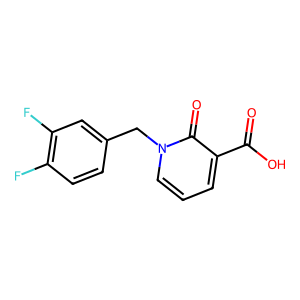
1-(3,4-Difluorobenzyl)-2-oxo-1,2-dihydropyridine-3-carboxylic acid
Names and Identifiers of 1001413-01-9
CAS Number |
1001413-01-9 |
|---|---|
MDL Number |
MFCD11111121 |
IUPAC Name |
1-[(3,4-difluorophenyl)methyl]-2-oxopyridine-3-carboxylic acid |
InChI |
InChI=1S/C13H9F2NO3/c14-10-4-3-8(6-11(10)15)7-16-5-1-2-9(12(16)17)13(18)19/h1-6H,7H2,(H,18,19) |
InChIKey |
CQQJYSYNXKUWPX-UHFFFAOYSA-N |
Canonical SMILES |
C1=CN(C(=O)C(=C1)C(=O)O)CC2=CC(=C(C=C2)F)F |
UNSPSC Code |
12352100 |
Physical and chemical properties of 1001413-01-9
Exact Mass |
265.05500 |
|---|---|
LogP |
1.87300 |
Molecular Formula |
C13H9F2NO3 |
Molecular Weight |
265.21200 |
PSA |
59.30000 |
Storage condition |
2-8°C |
Safety Information of 1001413-01-9

Applications of 1001413-01-9
This compound has several applications in scientific research:
- Pharmaceutical Development: Its unique structure makes it a candidate for developing new pharmaceuticals targeting various diseases.
- Chemical Biology: It serves as a tool compound for studying biological pathways and mechanisms due to its potential interactions with biological targets.
- Material Science: The compound may also find applications in material science due to its chemical stability and reactivity.
Interaction Studies of 1001413-01-9
Interaction studies involving 1-(3,4-Difluorobenzyl)-2-oxo-1,2-dihydropyridine-3-carboxylic acid are essential for understanding its mechanism of action and potential therapeutic effects. Preliminary investigations suggest that it may interact with specific protein targets or enzymes involved in inflammatory pathways. Further studies utilizing techniques such as molecular docking or biochemical assays will provide insights into its interaction profile and efficacy.
Biological Activity of 1001413-01-9
Research indicates that 1-(3,4-Difluorobenzyl)-2-oxo-1,2-dihydropyridine-3-carboxylic acid exhibits notable biological activities. Preliminary studies suggest it may possess anti-inflammatory and analgesic properties, although comprehensive pharmacological evaluations are required to fully elucidate its biological profile. Additionally, its structural features may confer potential as a lead compound in drug discovery efforts targeting specific therapeutic areas.
Physical sample testing spectrum (NMR) of 1001413-01-9

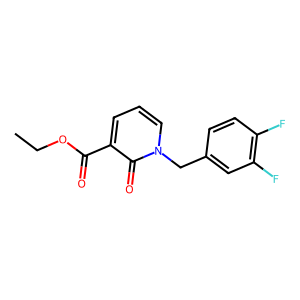 Cas:1001412-63-0

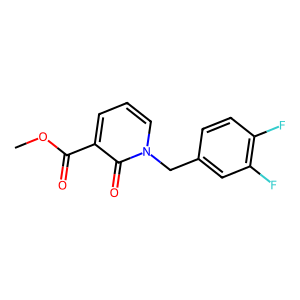 Cas:1001414-50-1