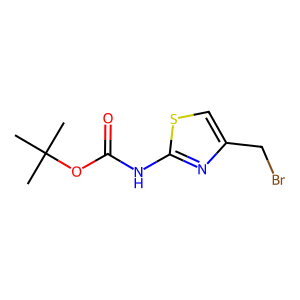
Tert-butyl 4-(bromomethyl)-1,3-thiazol-2-ylcarbamate
Names and Identifiers of 1001419-35-7
CAS Number |
1001419-35-7 |
|---|---|
MDL Number |
MFCD09751127 |
IUPAC Name |
tert-butyl N-[4-(bromomethyl)-1,3-thiazol-2-yl]carbamate |
InChI |
InChI=1S/C9H13BrN2O2S/c1-9(2,3)14-8(13)12-7-11-6(4-10)5-15-7/h5H,4H2,1-3H3,(H,11,12,13) |
InChIKey |
KBGNMMALBRNKSH-UHFFFAOYSA-N |
Canonical SMILES |
CC(C)(C)OC(=O)NC1=NC(=CS1)CBr |
UNSPSC Code |
12352100 |
Physical and chemical properties of 1001419-35-7
Acidity coefficient |
4.97±0.70(Predicted) |
|---|---|
Density |
1.5±0.1 g/cm3 |
Exact Mass |
291.988098 |
Index of Refraction |
1.600 |
LogP |
2.57 |
Molecular Formula |
C9H13BrN2O2S |
Molecular Weight |
293.181 |
PSA |
79.46000 |
Storage condition |
under inert gas (nitrogen or Argon) at 2-8°C |
Safety Information of 1001419-35-7

Applications of 1001419-35-7
tert-Butyl (4-(bromomethyl)thiazol-2-yl)carbamate has potential applications in medicinal chemistry as a building block for synthesizing biologically active compounds. Its derivatives may serve as lead compounds in drug discovery programs targeting various diseases due to their structural characteristics that facilitate interactions with biological macromolecules.
Interaction Studies of 1001419-35-7
Interaction studies involving tert-butyl (4-(bromomethyl)thiazol-2-yl)carbamate are essential for understanding its mechanism of action and potential therapeutic applications. Preliminary studies suggest that thiazole-containing compounds can interact with enzymes and receptors, influencing cellular pathways. Further research is needed to elucidate specific interactions and their implications for pharmacology.
Physical sample testing spectrum (NMR) of 1001419-35-7

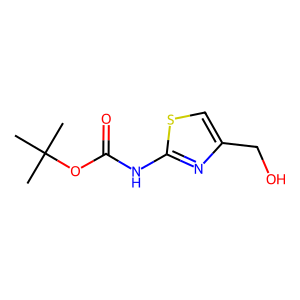 Cas:494769-44-7

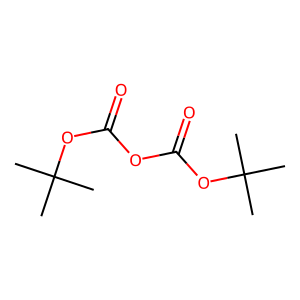 Cas:24424-99-5