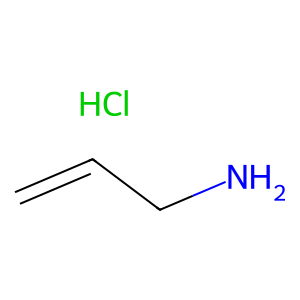
Allylamine hydrochloride
CAS No.:
10017-11-5
M. Wt:
93.555
M. Fa:
C3H8ClN
InChI Key:
MLGWTHRHHANFCC-UHFFFAOYSA-N
Appearance:
Solid
Names and Identifiers of 10017-11-5
CAS Number |
10017-11-5 |
|---|---|
EC Number |
415-050-2 |
MDL Number |
MFCD00054329 |
IUPAC Name |
prop-2-en-1-amine;hydrochloride |
InChI |
InChI=1S/C3H7N.ClH/c1-2-3-4;/h2H,1,3-4H2;1H |
InChIKey |
MLGWTHRHHANFCC-UHFFFAOYSA-N |
Canonical SMILES |
C=CCN.Cl |
UNII |
R2H25ILF98 |
Physical and chemical properties of 10017-11-5
Boiling Point |
54.3ºC at 760mmHg |
|---|---|
Exact Mass |
93.034531 |
Flash Point |
>110℃ |
Index of Refraction |
1.414 |
LogP |
1.63340 |
Melting Point |
106 °C |
Molecular Formula |
C3H8ClN |
Molecular Weight |
93.555 |
PSA |
26.02000 |
Vapour Pressure |
247mmHg at 25°C |
Water Solubility |
almost transparency |
Safety Information of 10017-11-5

Applications of 10017-11-5
Allylamine hydrochloride finds use in multiple fields:
- Polymer Science: It serves as a precursor for synthesizing poly(allylamine) and related polymers used in drug delivery systems and hydrogels.
- Biotechnology: Its properties make it suitable for applications in cell culture and tissue engineering.
- Chemical Industry: It is utilized in the production of surfactants, emulsifiers, and other chemical intermediates.
Interaction Studies of 10017-11-5
Research on the interactions of allylamine hydrochloride includes:
- Binding Studies: Investigations into its ability to bind anions such as perchlorate indicate its potential use in environmental remediation technologies.
- Cellular Interactions: Studies have demonstrated its role in enhancing cell adhesion and growth, suggesting its utility in regenerative medicine.
- Toxicological Assessments: Evaluations of its safety profile reveal potential risks associated with skin exposure and ingestion, necessitating careful handling procedures.
Biological Activity of 10017-11-5
Allylamine hydrochloride exhibits several biological activities:
- Antimicrobial Properties: Some studies suggest that allylamine derivatives possess antimicrobial activity against various pathogens.
- Cell Adhesion: Poly(allylamine hydrochloride) has been investigated for its ability to promote cell adhesion and proliferation, making it a candidate for biomedical applications such as tissue engineering.
- Toxicity: While it has beneficial properties, allylamine hydrochloride can be harmful if ingested or if it comes into contact with skin, potentially causing irritation or allergic reactions.
Physical sample testing spectrum (NMR) of 10017-11-5

 Cas:7688-51-9

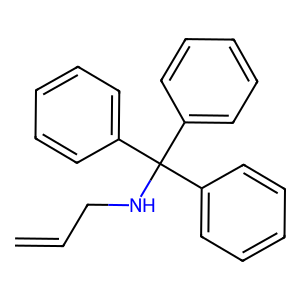 Cas:20020-75-1
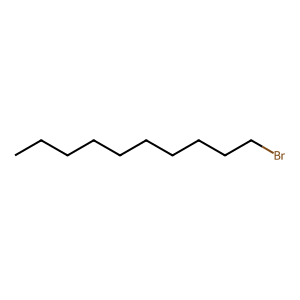 Cas:112-29-8

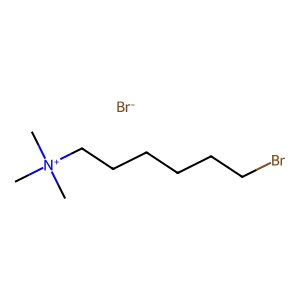 Cas:32765-81-4