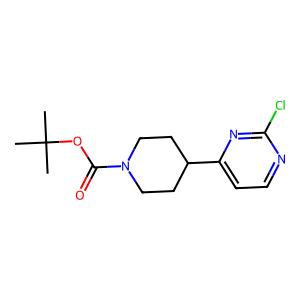
tert-butyl 4-(2-chloropyrimidin-4-yl)piperidine-1-carboxylate
Names and Identifiers of 1001754-82-0
CAS Number |
1001754-82-0 |
|---|---|
MDL Number |
MFCD10001439 |
IUPAC Name |
tert-butyl 4-(2-chloropyrimidin-4-yl)piperidine-1-carboxylate |
InChI |
InChI=1S/C14H20ClN3O2/c1-14(2,3)20-13(19)18-8-5-10(6-9-18)11-4-7-16-12(15)17-11/h4,7,10H,5-6,8-9H2,1-3H3 |
InChIKey |
QLZAPBRELYGZIY-UHFFFAOYSA-N |
Canonical SMILES |
CC(C)(C)OC(=O)N1CCC(C2=CC=NC(Cl)=N2)CC1 |
UNSPSC Code |
12352100 |
Physical and chemical properties of 1001754-82-0
Boiling Point |
436.1±38.0 °C at 760 mmHg |
|---|---|
Density |
1.2±0.1 g/cm3 |
Exact Mass |
297.124420 |
Flash Point |
217.5±26.8 °C |
Index of Refraction |
1.535 |
LogP |
1.74 |
Molecular Formula |
C14H20ClN3O2 |
Molecular Weight |
297.780 |
PSA |
55.32000 |
Storage condition |
2-8°C |
Vapour Pressure |
0.0±1.0 mmHg at 25°C |
Safety Information of 1001754-82-0

Applications of 1001754-82-0
tert-Butyl 4-(2-chloropyrimidin-4-yl)piperidine-1-carboxylate has several applications in medicinal chemistry and pharmacology:
- Drug Development: It serves as a lead compound for synthesizing new drugs targeting specific biological pathways.
- Research Tool: The compound is utilized in biochemical assays to study enzyme inhibition and receptor interactions.
- Chemical Probe: Its unique structure allows researchers to investigate biological mechanisms at a molecular level.
Interaction Studies of 1001754-82-0
Interaction studies involving tert-butyl 4-(2-chloropyrimidin-4-yl)piperidine-1-carboxylate focus on its binding affinity to various biological targets. These studies often employ techniques such as surface plasmon resonance and fluorescence spectroscopy to elucidate the nature of these interactions. Preliminary findings suggest that the compound demonstrates significant affinity for certain protein targets, which may correlate with its observed biological effects.
Biological Activity of 1001754-82-0
Research indicates that tert-butyl 4-(2-chloropyrimidin-4-yl)piperidine-1-carboxylate exhibits notable biological activities, particularly as a potential pharmacological agent. It has been studied for its inhibitory effects on certain enzymes and receptors involved in disease processes, including those related to cancer and neurological disorders. The compound's unique structure allows it to interact selectively with biological targets, which may lead to the development of new therapeutic agents.
Physical sample testing spectrum (NMR) of 1001754-82-0
