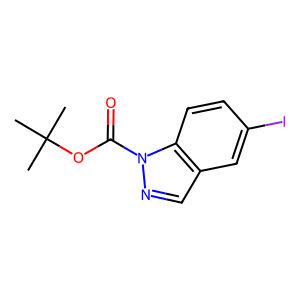
tert-Butyl 5-iodo-1H-indazole-1-carboxylate
Names and Identifiers of 1001907-23-8
CAS Number |
1001907-23-8 |
|---|---|
MDL Number |
MFCD12408346 |
IUPAC Name |
tert-butyl 5-iodoindazole-1-carboxylate |
InChI |
InChI=1S/C12H13IN2O2/c1-12(2,3)17-11(16)15-10-5-4-9(13)6-8(10)7-14-15/h4-7H,1-3H3 |
InChIKey |
PRGYWDOFNCWPOB-UHFFFAOYSA-N |
Canonical SMILES |
CC(C)(C)OC(=O)N1C2=C(C=C(C=C2)I)C=N1 |
UNSPSC Code |
12352100 |
Physical and chemical properties of 1001907-23-8
Exact Mass |
344.00200 |
|---|---|
H Bond Acceptors |
2 |
H Bond Donors |
0 |
LogP |
3.42410 |
Molecular Formula |
C12H13IN2O2 |
Molecular Weight |
344.14800 |
PSA |
44.12000 |
Safety Information of 1001907-23-8

Applications of 1001907-23-8
Tert-Butyl 5-iodo-1H-indazole-1-carboxylate has several applications in various fields:
- Pharmaceutical Development: As a scaffold for designing new drugs targeting cancer and infectious diseases.
- Organic Synthesis: Used as an intermediate in synthesizing other complex organic molecules.
- Research Tool: Employed in biological studies to understand mechanisms of action related to indazole derivatives.
The versatility of this compound makes it valuable in both academic and industrial settings.
Interaction Studies of 1001907-23-8
Interaction studies involving tert-butyl 5-iodo-1H-indazole-1-carboxylate focus on its binding affinities with biological targets. These studies often utilize techniques such as:
- Molecular Docking: To predict how the compound interacts with specific proteins involved in disease pathways.
- In Vitro Assays: To evaluate its efficacy against various cell lines and microbial strains.
Findings from these studies contribute to understanding its pharmacological profile and potential therapeutic uses.
Biological Activity of 1001907-23-8
Tert-Butyl 5-iodo-1H-indazole-1-carboxylate and its derivatives exhibit a broad spectrum of biological activities. Research indicates that indazole-containing compounds have shown:
- Anticancer Properties: They have been investigated for their ability to inhibit cancer cell proliferation and induce apoptosis in various cancer types.
- Antimicrobial Effects: Some studies suggest efficacy against bacterial and fungal infections.
- Anti-inflammatory and Analgesic Activities: These compounds may reduce inflammation and pain, making them candidates for treating inflammatory diseases.
The biological activity of this compound underscores its potential as a lead structure for drug development.
Physical sample testing spectrum (NMR) of 1001907-23-8

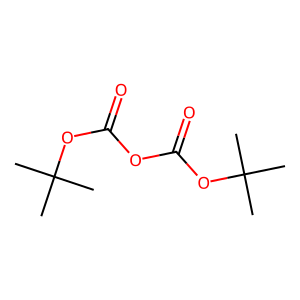 Cas:24424-99-5

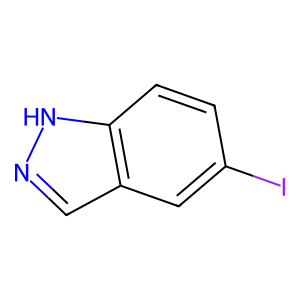 Cas:55919-82-9
