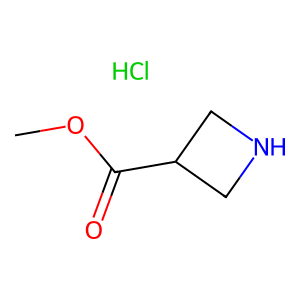
Methyl azetidine-3-carboxylate hydrochloride
Names and Identifiers of 100202-39-9
CAS Number |
100202-39-9 |
|---|---|
EC Number |
815-099-3 |
MDL Number |
MFCD01861758 |
IUPAC Name |
methyl azetidine-3-carboxylate;hydrochloride |
InChI |
InChI=1S/C5H9NO2.ClH/c1-8-5(7)4-2-6-3-4;/h4,6H,2-3H2,1H3;1H |
InChIKey |
UOCWTLBPYROHEF-UHFFFAOYSA-N |
Canonical SMILES |
COC(=O)C1CNC1.Cl |
UNSPSC Code |
12352100 |
Physical and chemical properties of 100202-39-9
Boiling Point |
190.9ºC at 760 mmHg |
|---|---|
Exact Mass |
151.040009 |
Flash Point |
69.3ºC |
LogP |
0.50960 |
Melting Point |
93.0 to 97.0 °C |
Molecular Formula |
C5H10ClNO2 |
Molecular Weight |
151.591 |
PSA |
38.33000 |
Storage condition |
Keep in dark place,Sealed in dry,Room Temperature |
Water Solubility |
Soluble in water |
Safety Information of 100202-39-9

Applications of 100202-39-9
Methyl azetidine-3-carboxylate hydrochloride finds applications primarily in organic synthesis as an intermediate for pharmaceuticals and agrochemicals. Its derivatives are explored for their potential use in drug development due to their biological activities. Furthermore, it may also serve as a building block for synthesizing complex molecules in medicinal chemistry.
Interaction Studies of 100202-39-9
Interaction studies involving methyl azetidine-3-carboxylate hydrochloride focus on its reactivity with various nucleophiles and electrophiles. The compound's ability to form stable intermediates makes it suitable for further derivatization in synthetic pathways. Additionally, understanding its interactions at a molecular level can provide insights into its biological mechanisms and potential therapeutic applications.
Physical sample testing spectrum (NMR) of 100202-39-9

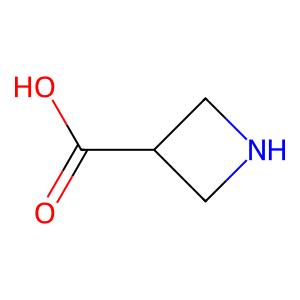 Cas:36476-78-5


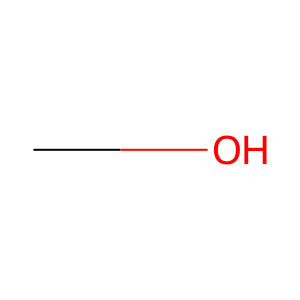 Cas:67-56-1
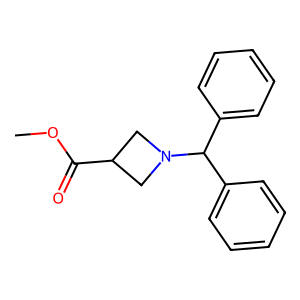 Cas:53871-06-0