![structure of 6-(4,4,5,5-Tetramethyl-1,3,2-dioxaborolan-2-yl)benzo[d]thiazole](https://molwiki.oss-cn-hongkong.aliyuncs.com/structure/47/1002309-47-8.svg)
6-(4,4,5,5-Tetramethyl-1,3,2-dioxaborolan-2-yl)benzo[d]thiazole
Names and Identifiers of 1002309-47-8
CAS Number |
1002309-47-8 |
|---|---|
EC Number |
801-858-6 |
MDL Number |
MFCD12408395 |
IUPAC Name |
6-(4,4,5,5-tetramethyl-1,3,2-dioxaborolan-2-yl)-1,3-benzothiazole |
InChI |
InChI=1S/C13H16BNO2S/c1-12(2)13(3,4)17-14(16-12)9-5-6-10-11(7-9)18-8-15-10/h5-8H,1-4H3 |
InChIKey |
VLJNKSRMMHATGX-UHFFFAOYSA-N |
Canonical SMILES |
B1(OC(C(O1)(C)C)(C)C)C2=CC3=C(C=C2)N=CS3 |
UNSPSC Code |
12352100 |
Physical and chemical properties of 1002309-47-8
Acidity coefficient |
0.53±0.10(Predicted) |
|---|---|
Boiling Point |
380.6±15.0 °C(Predicted) |
Density |
1.17±0.1 g/cm3(Predicted) |
Exact Mass |
261.09900 |
LogP |
2.59550 |
Molecular Formula |
C13H16BNO2S |
Molecular Weight |
261.14800 |
PSA |
59.59000 |
Storage condition |
2-8°C |
Safety Information of 1002309-47-8

Applications of 1002309-47-8
The applications of 6-(4,4,5,5-tetramethyl-1,3,2-dioxaborolan-2-yl)benzo[d]thiazole are diverse:
- Medicinal Chemistry: Due to its ability to interact with biological targets, it is explored as a potential therapeutic agent.
- Organic Synthesis: It serves as a valuable intermediate in the synthesis of more complex organic molecules.
- Material Science: The compound may also find applications in developing materials with specific electronic or optical properties due to its unique structural characteristics.
Interaction Studies of 1002309-47-8
Studies on the interactions of 6-(4,4,5,5-tetramethyl-1,3,2-dioxaborolan-2-yl)benzo[d]thiazole indicate that it can form stable complexes with various protein targets. These interactions are primarily mediated through covalent bonding at active sites within enzymes. Research has shown that these interactions can lead to significant changes in enzyme activity and stability, making this compound a candidate for further exploration in drug development.
Biological Activity of 1002309-47-8
6-(4,4,5,5-Tetramethyl-1,3,2-dioxaborolan-2-yl)benzo[d]thiazole exhibits significant biological activities. It has been shown to interact with various enzymes, particularly lipoxygenases and proteins involved in cellular signaling pathways. The compound's mechanism of action often involves the formation of covalent bonds with active site residues of enzymes, leading to either inhibition or activation of enzymatic activity. This interaction can impact several biochemical pathways and may influence processes such as inflammation and cell proliferation.
Physical sample testing spectrum (NMR) of 1002309-47-8

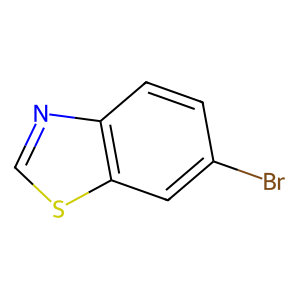 Cas:53218-26-1

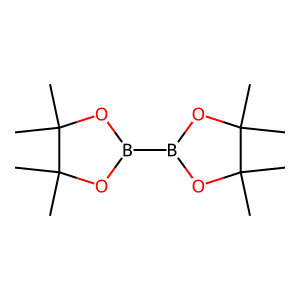 Cas:73183-34-3
