
1-Methyl-5-(4,4,5,5-tetramethyl-1,3,2-dioxaborolan-2-yl)pyridin-2(1H)-one
Names and Identifiers of 1002309-52-5
CAS Number |
1002309-52-5 |
|---|---|
EC Number |
800-849-4 |
MDL Number |
MFCD11044683 |
IUPAC Name |
1-methyl-5-(4,4,5,5-tetramethyl-1,3,2-dioxaborolan-2-yl)pyridin-2-one |
InChI |
InChI=1S/C12H18BNO3/c1-11(2)12(3,4)17-13(16-11)9-6-7-10(15)14(5)8-9/h6-8H,1-5H3 |
InChIKey |
IJUNZKOKAXJGRQ-UHFFFAOYSA-N |
Canonical SMILES |
B1(OC(C(O1)(C)C)(C)C)C2=CN(C(=O)C=C2)C |
UNSPSC Code |
12352100 |
Physical and chemical properties of 1002309-52-5
Acidity coefficient |
0.03±0.62(Predicted) |
|---|---|
Boiling Point |
287.1±50.0 °C at 760 mmHg |
Density |
1.1±0.1 g/cm3 |
Exact Mass |
235.137970 |
Flash Point |
127.4±30.1 °C |
Index of Refraction |
1.509 |
LogP |
0.68450 |
Molecular Formula |
C12H18BNO3 |
Molecular Weight |
235.087 |
PSA |
40.46000 |
Storage condition |
2-8°C |
Vapour Pressure |
0.0±0.6 mmHg at 25°C |
Safety Information of 1002309-52-5

Applications of 1002309-52-5
This compound finds applications primarily in organic synthesis as a building block for more complex molecules. Its utility in Suzuki coupling reactions makes it valuable in the pharmaceutical industry for developing new drugs and agrochemicals. Furthermore, due to its unique structural features, it may have applications in materials science and nanotechnology.
Interaction Studies of 1002309-52-5
Interaction studies involving 1-Methyl-5-(4,4,5,5-tetramethyl-1,3,2-dioxaborolan-2-yl)pyridin-2(1H)-one have focused on its reactivity with various nucleophiles and electrophiles. These studies are crucial for understanding the compound's behavior in biological systems and its potential interactions with biomolecules. The insights gained from these studies can inform the design of new derivatives with enhanced biological activity.
Physical sample testing spectrum (NMR) of 1002309-52-5

 Cas:1054483-78-1

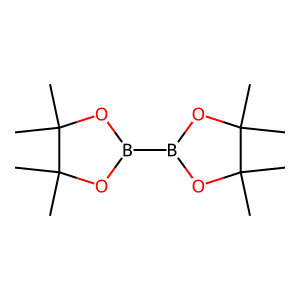 Cas:73183-34-3

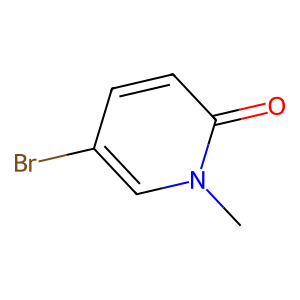 Cas:81971-39-3