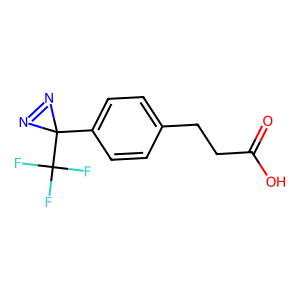
3-(4-(3-(Trifluoromethyl)-3H-diazirin-3-yl)phenyl)propanoic acid
Names and Identifiers of 1002328-44-0
CAS Number |
1002328-44-0 |
|---|---|
MDL Number |
MFCD22683683 |
IUPAC Name |
3-[4-[3-(trifluoromethyl)diazirin-3-yl]phenyl]propanoic acid |
InChI |
InChI=1S/C11H9F3N2O2/c12-11(13,14)10(15-16-10)8-4-1-7(2-5-8)3-6-9(17)18/h1-2,4-5H,3,6H2,(H,17,18) |
InChIKey |
JGDZOJLVEAQZEN-UHFFFAOYSA-N |
Canonical SMILES |
C1=CC(=CC=C1CCC(=O)O)C2(N=N2)C(F)(F)F |
UNII |
Z9AGY24PUL |
UNSPSC Code |
12352100 |
Physical and chemical properties of 1002328-44-0
Exact Mass |
258.06200 |
|---|---|
H Bond Acceptors |
4 |
H Bond Donors |
1 |
LogP |
1.75590 |
Molecular Formula |
C11H9F3N2O2 |
Molecular Weight |
258.19700 |
PSA |
62.02000 |
Safety Information of 1002328-44-0

Applications of 1002328-44-0
The unique properties of 3-(4-(3-(Trifluoromethyl)-3H-diazirin-3-yl)phenyl)propanoic acid lend it to various applications:
- Photochemistry: Used as a photoreactive probe in studies involving biomolecular interactions.
- Materials Science: Employed in the development of advanced materials such as polymers that require specific cross-linking capabilities.
- Drug Development: Potential use in synthesizing novel pharmaceuticals through targeted labeling and modification of drug candidates .
Interaction Studies of 1002328-44-0
Interaction studies involving 3-(4-(3-(Trifluoromethyl)-3H-diazirin-3-yl)phenyl)propanoic acid focus on its ability to label proteins and other biomolecules upon irradiation. These studies utilize techniques such as mass spectrometry and fluorescence microscopy to analyze binding interactions and conformational changes in target proteins. The trifluoromethyl group enhances the compound's stability during these interactions, making it suitable for live-cell imaging applications .
Biological Activity of 1002328-44-0
The biological activity of 3-(4-(3-(Trifluoromethyl)-3H-diazirin-3-yl)phenyl)propanoic acid has been explored in the context of photolabeling studies. Diazirines are known for their ability to label biomolecules upon irradiation, allowing researchers to investigate protein-protein interactions, receptor-ligand binding, and other biological processes. The trifluoromethyl group contributes to the compound's stability and solubility in biological media, enhancing its applicability in cellular studies .
Physical sample testing spectrum (NMR) of 1002328-44-0
