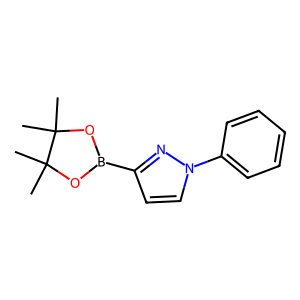
1-Phenyl-3-(4,4,5,5-tetramethyl-1,3,2-dioxaborolan-2-yl)-1H-pyrazole
Names and Identifiers of 1002334-13-5
CAS Number |
1002334-13-5 |
|---|---|
EC Number |
847-774-3 |
MDL Number |
MFCD16659786 |
IUPAC Name |
1-phenyl-3-(4,4,5,5-tetramethyl-1,3,2-dioxaborolan-2-yl)pyrazole |
InChI |
InChI=1S/C15H19BN2O2/c1-14(2)15(3,4)20-16(19-14)13-10-11-18(17-13)12-8-6-5-7-9-12/h5-11H,1-4H3 |
InChIKey |
UBYYGXCGPBWGKO-UHFFFAOYSA-N |
Canonical SMILES |
B1(OC(C(O1)(C)C)(C)C)C2=NN(C=C2)C3=CC=CC=C3 |
UNSPSC Code |
12352100 |
Physical and chemical properties of 1002334-13-5
Boiling Point |
389.8±15.0 °C at 760 mmHg |
|---|---|
Density |
1.1±0.1 g/cm3 |
Exact Mass |
270.153961 |
Flash Point |
189.6±20.4 °C |
Index of Refraction |
1.546 |
LogP |
2.17150 |
Molecular Formula |
C15H19BN2O2 |
Molecular Weight |
270.135 |
PSA |
36.28000 |
Storage condition |
Inert atmosphere,Store in freezer, under -20°C |
Vapour Pressure |
0.0±0.9 mmHg at 25°C |
Safety Information of 1002334-13-5

Applications of 1002334-13-5
The compound finds applications primarily in organic synthesis and medicinal chemistry. Its role as a boronic ester allows it to participate in cross-coupling reactions essential for constructing complex organic molecules. Additionally, due to its potential biological activities, it may be investigated as a lead compound in drug discovery processes targeting various diseases.
Interaction Studies of 1002334-13-5
Interaction studies involving 1-Phenyl-3-(4,4,5,5-tetramethyl-1,3,2-dioxaborolan-2-yl)-1H-pyrazole often focus on its reactivity with biological macromolecules or other small molecules. The compound's ability to form complexes with proteins or nucleic acids could be explored through techniques such as:
- NMR Spectroscopy: To study binding interactions.
- Mass Spectrometry: For analyzing reaction products and binding affinities.
- Molecular Docking Studies: To predict potential binding sites and affinities in target proteins.
Biological Activity of 1002334-13-5
While specific biological activity data for 1-Phenyl-3-(4,4,5,5-tetramethyl-1,3,2-dioxaborolan-2-yl)-1H-pyrazole may be limited, compounds containing pyrazole rings are often explored for their potential pharmacological properties. Pyrazoles have been associated with various biological activities including anti-inflammatory, analgesic, and anticancer effects. The boron moiety may also contribute to biological interactions by influencing the compound's solubility and reactivity with biological targets.
Physical sample testing spectrum (NMR) of 1002334-13-5
