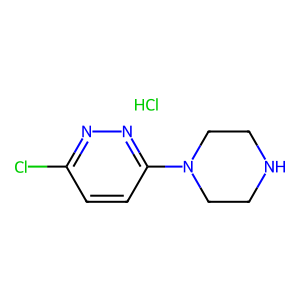
3-Chloro-6-piperazinopyridazine Hydrochloride
Names and Identifiers of 100241-11-0
CAS Number |
100241-11-0 |
|---|---|
MDL Number |
MFCD16620387 |
IUPAC Name |
3-chloro-6-piperazin-1-ylpyridazine;hydrochloride |
InChI |
InChI=1S/C8H11ClN4.ClH/c9-7-1-2-8(12-11-7)13-5-3-10-4-6-13;/h1-2,10H,3-6H2;1H |
InChIKey |
NMDKBLUVQLFFOA-UHFFFAOYSA-N |
Canonical SMILES |
C1CN(CCN1)C2=NN=C(C=C2)Cl.Cl |
UNSPSC Code |
12352100 |
Physical and chemical properties of 100241-11-0
Exact Mass |
234.043900 |
|---|---|
LogP |
1.73540 |
Molecular Formula |
C8H12Cl2N4 |
Molecular Weight |
235.114 |
PSA |
41.05000 |
Storage condition |
2-8°C |
Safety Information of 100241-11-0

Applications of 100241-11-0
3-Chloro-6-piperazinopyridazine Hydrochloride has several applications in various fields:
- Pharmaceutical Development: It serves as a lead compound for developing new drugs targeting neurological disorders and cancer.
- Research: Utilized in studies exploring receptor interactions and enzyme inhibition.
- Chemical Synthesis: Acts as an intermediate in synthesizing other biologically active compounds or pharmaceuticals .
Interaction Studies of 100241-11-0
Interaction studies involving 3-Chloro-6-piperazinopyridazine Hydrochloride have focused on its pharmacokinetics and pharmacodynamics. It has been shown to interact with various receptors and enzymes, influencing neurotransmitter levels and potentially modulating physiological responses. Notably, it may act as a substrate for P-glycoprotein, affecting its bioavailability and distribution within biological systems .
Biological Activity of 100241-11-0
Research indicates that 3-Chloro-6-piperazinopyridazine Hydrochloride exhibits notable biological activities, particularly in the realm of pharmacology. It has been studied for its potential as an antitumor agent and possesses properties that may influence neurotransmitter systems. The compound's ability to cross the blood-brain barrier suggests its utility in treating central nervous system disorders . Furthermore, it has shown activity against certain pathogens, indicating potential applications in antimicrobial therapies .
Physical sample testing spectrum (NMR) of 100241-11-0

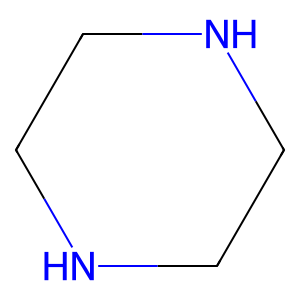 Cas:110-85-0

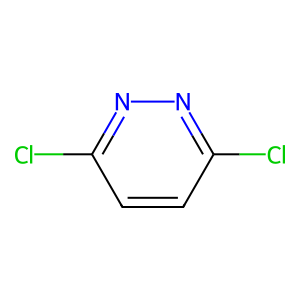 Cas:141-30-0

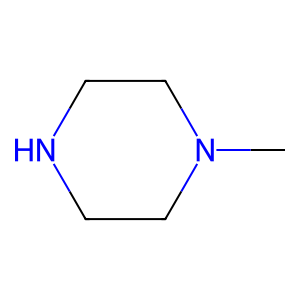 Cas:109-01-3