
7-(trifluoromethyl)-2,3-dihydro-1H-inden-1-one
Names and Identifiers of 1003048-68-7
CAS Number |
1003048-68-7 |
|---|---|
MDL Number |
MFCD11040251 |
IUPAC Name |
7-(trifluoromethyl)-2,3-dihydroinden-1-one |
InChI |
InChI=1S/C10H7F3O/c11-10(12,13)7-3-1-2-6-4-5-8(14)9(6)7/h1-3H,4-5H2 |
InChIKey |
RHHGHWBHOQXKNZ-UHFFFAOYSA-N |
Canonical SMILES |
C1CC(=O)C2=C1C=CC=C2C(F)(F)F |
UNSPSC Code |
12352100 |
Physical and chemical properties of 1003048-68-7
Boiling Point |
242.5°C at 760 mmHg |
|---|---|
Exact Mass |
200.04500 |
LogP |
2.83430 |
Molecular Formula |
C10H7F3O |
Molecular Weight |
200.15700 |
PSA |
17.07000 |
Storage condition |
under inert gas (nitrogen or Argon) at 2-8°C |
Safety Information of 1003048-68-7

Applications of 1003048-68-7
7-(Trifluoromethyl)-2,3-dihydro-1H-inden-1-one finds applications in various fields:
Medicinal Chemistry: It serves as a pharmaceutical intermediate in drug development due to its potential biological activity.
Material Science: The compound is utilized in creating materials with unique properties, particularly in agrochemicals and specialty chemicals.
Research
Interaction Studies of 1003048-68-7
Studies have shown that 7-(trifluoromethyl)-2,3-dihydro-1H-inden-1-one interacts with various biological receptors and enzymes. Its trifluoromethyl group enhances lipophilicity, which may improve membrane permeability and bioavailability. Ongoing research aims to elucidate its mechanisms of action and potential therapeutic uses against specific diseases.
Similar Compounds: ComparisonSeveral compounds share structural similarities with 7-(trifluoromethyl)-2,3-dihydro-1H-inden-1-one. Below is a comparison highlighting its uniqueness:
| Compound Name | Structural Features | Unique Characteristics |
|---|---|---|
| 6-(Trifluoromethyl)-1-indanone | Contains a ketone group without the dihydro structure | Lacks the dihydro component, affecting reactivity |
| 5-(Trifluoromethyl)-2,3-dihydro-1H-inden-1-one | Similar dihydro structure but different substitution | Different position of trifluoromethyl group |
| 6-(Trifluoromethyl)-3,4-dihydronaphthalen-1(2H)-one | Naphthalene derivative with trifluoromethyl group | More complex aromatic system compared to indenone |
| 4-(Trifluoromethyl)-1-indanone | Lacks the dihydro component | Different positioning of the trifluoromethyl group |
| 1-(2,4-Bis(trifluoromethyl)phenyl)ethanone | Contains multiple trifluoromethyl groups | More complex substitution pattern |
Biological Activity of 1003048-68-7
Research indicates that 7-(trifluoromethyl)-2,3-dihydro-1H-inden-1-one exhibits potential biological activities. It has been investigated for its role in enzyme inhibition and receptor modulation, suggesting possible therapeutic applications. The presence of the trifluoromethyl group may enhance its bioactivity by improving binding affinity to biological targets.
Physical sample testing spectrum (NMR) of 1003048-68-7

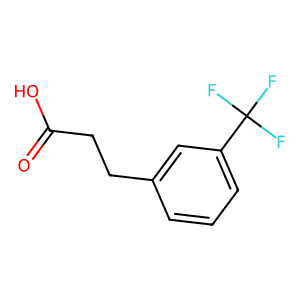 Cas:585-50-2
