
4-Bromo-7-fluoro-2,3-dihydro-1H-inden-1-one
Names and Identifiers of 1003048-72-3
CAS Number |
1003048-72-3 |
|---|---|
EC Number |
810-183-6 |
MDL Number |
MFCD17677340 |
IUPAC Name |
4-bromo-7-fluoro-2,3-dihydroinden-1-one |
InChI |
InChI=1S/C9H6BrFO/c10-6-2-3-7(11)9-5(6)1-4-8(9)12/h2-3H,1,4H2 |
InChIKey |
HNXHWYGTXAJDEC-UHFFFAOYSA-N |
Canonical SMILES |
C1CC(=O)C2=C(C=CC(=C21)Br)F |
UNSPSC Code |
12352100 |
Physical and chemical properties of 1003048-72-3
Boiling Point |
310.7±42.0 °C at 760 mmHg |
|---|---|
Density |
1.7±0.1 g/cm3 |
Exact Mass |
227.958603 |
Flash Point |
141.7±27.9 °C |
Index of Refraction |
1.599 |
LogP |
3.00 |
Molecular Formula |
C9H6BrFO |
Molecular Weight |
229.046 |
PSA |
17.07000 |
Vapour Pressure |
0.0±0.7 mmHg at 25°C |
Safety Information of 1003048-72-3

Applications of 1003048-72-3
4-Bromo-7-fluoro-2,3-dihydro-1H-inden-1-one serves various roles in scientific research:
- Chemistry: Acts as a building block for synthesizing complex organic molecules and pharmaceuticals.
- Biology: Explored for its biological activities, particularly in antimicrobial and anticancer research.
- Medicine: Investigated as a precursor for developing new therapeutic agents.
- Industry: Used in producing specialty chemicals with specific properties.
Interaction Studies of 1003048-72-3
The interaction of 4-Bromo-7-fluoro-2,3-dihydro-1H-inden-1-one with biological targets is an area of active research. Its halogen atoms may facilitate unique binding interactions through halogen bonding, which can modulate the activity of enzymes and receptors. This characteristic is critical for understanding its potential therapeutic effects and optimizing its use in drug design.
Biological Activity of 1003048-72-3
Research indicates that 4-Bromo-7-fluoro-2,3-dihydro-1H-inden-1-one exhibits potential biological activities, including antimicrobial and anticancer properties. Its unique halogen substituents may enhance its interaction with biological targets, influencing pathways involved in disease processes. Ongoing investigations focus on its efficacy as a precursor in drug development, particularly for novel therapeutic agents.
Physical sample testing spectrum (NMR) of 1003048-72-3
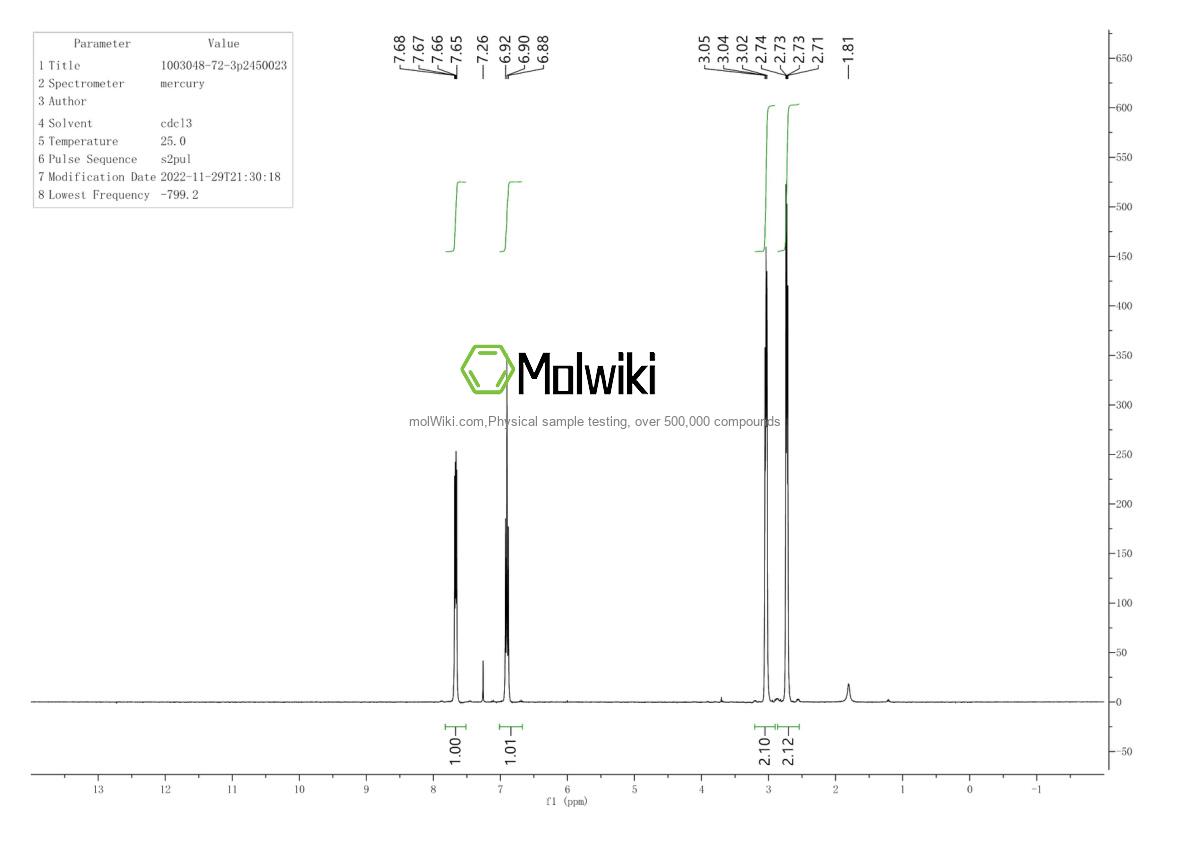
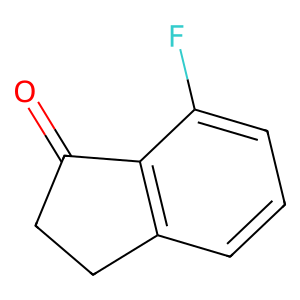 Cas:651735-59-0
