
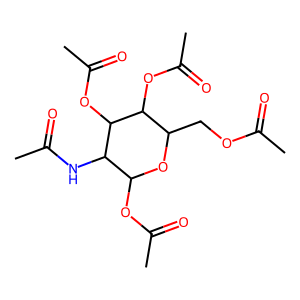
6-(Acetoxymethyl)-3-aminotetrahydro-2h-pyran-2,4,5-triyl triacetate hydrochloride
Names and Identifiers of 10034-20-5
CAS Number |
10034-20-5 |
|---|---|
MDL Number |
MFCD01075204 |
IUPAC Name |
[(2R,3S,4R,5R,6S)-3,4,6-triacetyloxy-5-aminooxan-2-yl]methyl acetate;hydrochloride |
InChI |
InChI=1S/C14H21NO9.ClH/c1-6(16)20-5-10-12(21-7(2)17)13(22-8(3)18)11(15)14(24-10)23-9(4)19;/h10-14H,5,15H2,1-4H3;1H/t10-,11-,12-,13-,14-;/m1./s1 |
InChIKey |
BQLUYAHMYOLHBX-XAWYEFCRSA-N |
Canonical SMILES |
CC(=O)OCC1C(C(C(C(O1)OC(=O)C)N)OC(=O)C)OC(=O)C.Cl |
Isomeric SMILES |
CC(=O)OC[C@@H]1[C@H]([C@@H]([C@H]([C@@H](O1)OC(=O)C)N)OC(=O)C)OC(=O)C.Cl |
UNSPSC Code |
12352100 |
Physical and chemical properties of 10034-20-5
Boiling Point |
429.5ºC at 760mmHg |
|---|---|
Exact Mass |
383.098297 |
Flash Point |
158.3ºC |
LogP |
0.53050 |
Melting Point |
197-200ºC |
Molecular Formula |
C14H22ClNO9 |
Molecular Weight |
383.779 |
optical activity |
[α]/D 30.0±2.0°, c = 1 in H2O |
PSA |
140.45000 |
RTECS |
LZ6574000 |
Solubility |
Methanol (Slightly), Water (Slightly) |
Storage condition |
Inert atmosphere,2-8°C |
Vapour Pressure |
1.39E-07mmHg at 25°C |
Water Solubility |
Soluble in water at 10mg/ml |
Safety Information of 10034-20-5

Interaction Studies of 10034-20-5
Research indicates that beta-Glucosamine, tetraacetate, hydrochloride interacts with various biological systems. Its interaction with cellular membranes has been studied for potential metabolic inhibition effects on glycoconjugates. These interactions are crucial for understanding its therapeutic potential and mechanisms of action within biological systems.
Biological Activity of 10034-20-5
This compound exhibits significant biological activity, particularly in the context of joint health. It primarily targets articular tissues such as cartilage and synovial membranes. The mechanism of action involves enhancing the synthesis of glycosaminoglycans, essential components of cartilage, which helps in retarding cartilage degradation and improving joint function. Additionally, beta-Glucosamine, tetraacetate, hydrochloride has been shown to reduce inflammation and enhance cellular redox status, making it a candidate for therapeutic interventions in inflammatory conditions.
Physical sample testing spectrum (NMR) of 10034-20-5

 Cas:3006-60-8

 Cas:3068-34-6