
7-(Diethylamino)coumarin-3-carbohydrazide
Names and Identifiers of 100343-98-4
CAS Number |
100343-98-4 |
|---|---|
EC Number |
635-183-1 |
IUPAC Name |
7-(diethylamino)-2-oxochromene-3-carbohydrazide |
InChI |
InChI=1S/C14H17N3O3/c1-3-17(4-2)10-6-5-9-7-11(13(18)16-15)14(19)20-12(9)8-10/h5-8H,3-4,15H2,1-2H3,(H,16,18) |
InChIKey |
LYBMHAINSFEHRL-UHFFFAOYSA-N |
Canonical SMILES |
CCN(CC)C1=CC2=C(C=C1)C=C(C(=O)O2)C(=O)NN |
Physical and chemical properties of 100343-98-4
BRN |
5574454 |
|---|---|
Density |
1.3±0.1 g/cm3 |
Exact Mass |
275.126984 |
Index of Refraction |
1.621 |
LogP |
2.41 |
Melting Point |
162-165 °C(Solv: chloroform (67-66-3); hexane (110-54-3)) |
Molecular Formula |
C14H17N3O3 |
Molecular Weight |
275.303 |
PSA |
88.57000 |
Solubility |
DMF: soluble |
Water Solubility |
DMF: soluble |
λmax |
420 nm (MeOH) |
Safety Information of 100343-98-4

Applications of 100343-98-4
This compound has several notable applications:
- Analytical Chemistry: It serves as a derivatizing agent for the detection of carboxylic acids and carbonylated molecules.
- Biochemical Research: Used for labeling proteins and other biomolecules containing carbonyl groups.
- Food Analysis: Employed in detecting lipid peroxidation products in food samples.
Interaction Studies of 100343-98-4
Research indicates that 7-(Diethylamino)coumarin-3-carbohydrazide can selectively label aldehydes and epoxides, facilitating their identification and semi-quantification. Studies have demonstrated its effectiveness in deriving both low molecular weight and high molecular weight carbonylated lipid peroxidation products. The compound's interactions are influenced by environmental conditions such as temperature and solvent choice.
Biological Activity of 100343-98-4
The primary biological activity of 7-(Diethylamino)coumarin-3-carbohydrazide lies in its ability to detect lipid peroxidation products, which are indicative of oxidative stress in biological systems. This compound interacts with its targets through derivatization, influencing biochemical pathways related to lipid metabolism. Its solubility in various solvents such as dimethylformamide, acetonitrile, chloroform, and methanol facilitates its application in diverse experimental settings.
Physical sample testing spectrum (NMR) of 100343-98-4

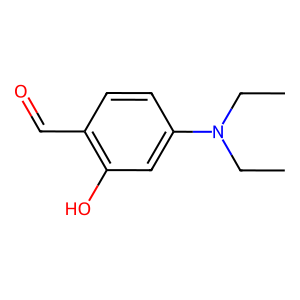 Cas:17754-90-4

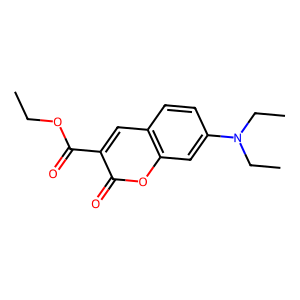 Cas:28705-46-6