
R(-)-8A-METHYL-3,4,8,8A-TETRAHYDRO-1,6(2H,7H)-NAPHTHALENEDIONE
CAS No.:
100348-93-4
M. Wt:
178.22800
M. Fa:
C11H14O2
InChI Key:
DNHDRUMZDHWHKG-LLVKDONJSA-N
Appearance:
Yellow Solid
Names and Identifiers of 100348-93-4
CAS Number |
100348-93-4 |
|---|---|
MDL Number |
MFCD01545794 |
IUPAC Name |
(8aR)-8a-methyl-1,2,3,4,6,7,8,8a-octahydronaphthalene-1,6-dione |
InChI |
InChI=1S/C11H14O2/c1-11-6-5-9(12)7-8(11)3-2-4-10(11)13/h7H,2-6H2,1H3/t11-/m1/s1 |
InChIKey |
DNHDRUMZDHWHKG-LLVKDONJSA-N |
Canonical SMILES |
C[C@@]12CCC(=O)C=C1CCCC2=O |
UNSPSC Code |
12352100 |
Physical and chemical properties of 100348-93-4
Boiling Point |
325.548ºC at 760 mmHg |
|---|---|
Density |
1.109g/cm3 |
Exact Mass |
178.09900 |
Flash Point |
121.986ºC |
H Bond Acceptors |
2 |
H Bond Donors |
0 |
Index of Refraction |
1.519 |
LogP |
2.03500 |
Melting Point |
49-51ºC |
Molecular Formula |
C11H14O2 |
Molecular Weight |
178.22800 |
PSA |
34.14000 |
Vapour Pressure |
0mmHg at 25°C |
Safety Information of 100348-93-4

Applications of 100348-93-4
This compound finds applications in various fields:
- Organic synthesis: As a precursor for synthesizing complex natural products and pharmaceuticals.
- Material science: Potential use in developing new materials due to its structural properties.
- Biochemistry: Utilized in enzyme studies and metabolic pathway investigations.
Its versatility makes it a valuable compound in both academic and industrial research settings.
Interaction Studies of 100348-93-4
Interaction studies involving (R)-(-)-8a-Methyl-3,4,8,8a-tetrahydro-1,6(2H,7H)-naphthalenedione focus on its binding affinity with biological targets. Key areas include:
- Protein-ligand interactions: Investigating how this compound binds to specific enzymes or receptors.
- Mechanistic studies: Understanding how structural features influence its biological activity.
These studies are crucial for developing derivatives with enhanced efficacy or reduced side effects.
Biological Activity of 100348-93-4
(R)-(-)-8a-Methyl-3,4,8,8a-tetrahydro-1,6(2H,7H)-naphthalenedione exhibits notable biological activities. It has been investigated for its potential:
- Antimicrobial properties: Showing efficacy against various bacterial strains.
- Antitumor activity: Preliminary studies suggest it may inhibit cancer cell proliferation.
- Enzyme inhibition: It may act as an inhibitor for certain enzymes involved in metabolic pathways.
Further research is necessary to fully elucidate its biological mechanisms and therapeutic potential.
Physical sample testing spectrum (NMR) of 100348-93-4

 Cas:1193-55-1

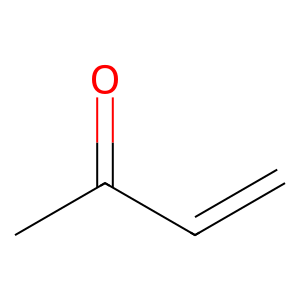 Cas:78-94-4
