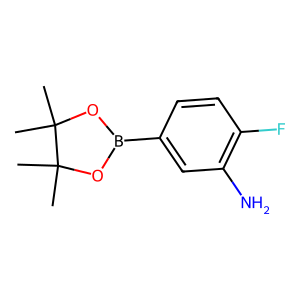
2-Fluoro-5-(4,4,5,5-tetramethyl-1,3,2-dioxaborolan-2-yl)aniline
Names and Identifiers of 1003575-43-6
CAS Number |
1003575-43-6 |
|---|---|
MDL Number |
MFCD11044430 |
IUPAC Name |
2-fluoro-5-(4,4,5,5-tetramethyl-1,3,2-dioxaborolan-2-yl)aniline |
InChI |
InChI=1S/C12H17BFNO2/c1-11(2)12(3,4)17-13(16-11)8-5-6-9(14)10(15)7-8/h5-7H,15H2,1-4H3 |
InChIKey |
VXNIVUKZNDRJBW-UHFFFAOYSA-N |
Canonical SMILES |
B1(OC(C(O1)(C)C)(C)C)C2=CC(=C(C=C2)F)N |
UNSPSC Code |
12352100 |
Physical and chemical properties of 1003575-43-6
Acidity coefficient |
3.19±0.10(Predicted) |
|---|---|
Boiling Point |
336.8±32.0 °C(Predicted) |
Density |
1.11±0.1 g/cm3(Predicted) |
Exact Mass |
237.13400 |
LogP |
2.28830 |
Melting Point |
54.0-55.1 °C |
Molecular Formula |
C12H17BFNO2 |
Molecular Weight |
237.07800 |
PSA |
44.48000 |
Storage condition |
under inert gas (nitrogen or Argon) at 2–8 °C |
Safety Information of 1003575-43-6

Applications of 1003575-43-6
The compound has diverse applications in various fields:
- Organic Synthesis: It serves as a building block for complex organic molecules, including pharmaceuticals and agrochemicals.
- Biological Imaging: Its unique electronic properties make it suitable for developing fluorescent probes and imaging agents.
- Material Science: Utilized in producing advanced materials such as polymers and electronic components.
Interaction Studies of 1003575-43-6
The mechanism of action of 2-Fluoro-5-(4,4,5,5-tetramethyl-1,3,2-dioxaborolan-2-yl)aniline involves reversible covalent bonding with diols and other nucleophiles due to the boronic ester group. This interaction makes it valuable in enzyme inhibition and receptor modulation studies. The fluorine atom enhances the compound's biological activity by improving its pharmacokinetic properties.
Biological Activity of 1003575-43-6
While specific biological activity data for 2-Fluoro-5-(4,4,5,5-tetramethyl-1,3,2-dioxaborolan-2-yl)aniline is limited, the compound's boronic ester functionality allows it to interact with biological targets effectively. It has potential applications in medicinal chemistry as a precursor for synthesizing biologically active compounds such as enzyme inhibitors and receptor modulators. The presence of the fluorine atom contributes to its lipophilicity and metabolic stability.
Physical sample testing spectrum (NMR) of 1003575-43-6

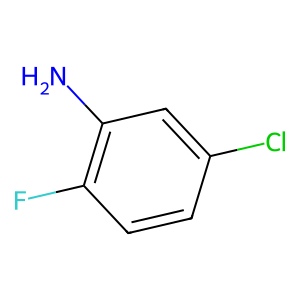 Cas:2106-05-0

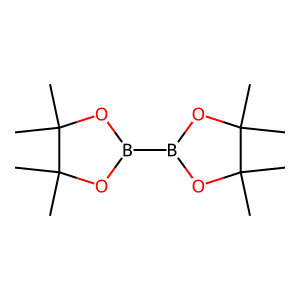 Cas:73183-34-3

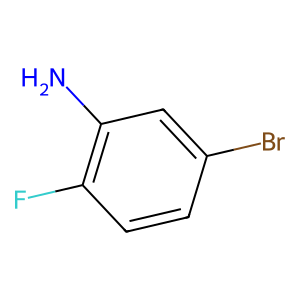 Cas:2924-09-6
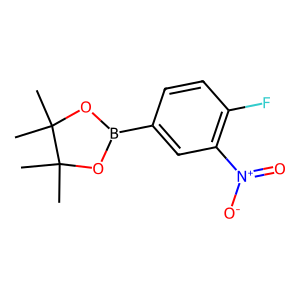 Cas:1218791-09-3