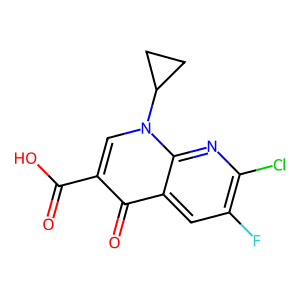
7-Chloro-1-cyclopropyl-6-fluoro-4-oxo-1,4-dihydro-1,8-naphthyridine-3-carboxylic acid
Names and Identifiers of 100361-18-0
CAS Number |
100361-18-0 |
|---|---|
IUPAC Name |
7-chloro-1-cyclopropyl-6-fluoro-4-oxo-1,8-naphthyridine-3-carboxylic acid |
InChI |
InChI=1S/C12H8ClFN2O3/c13-10-8(14)3-6-9(17)7(12(18)19)4-16(5-1-2-5)11(6)15-10/h3-5H,1-2H2,(H,18,19) |
InChIKey |
OXNZWNNMJBOZQO-UHFFFAOYSA-N |
Canonical SMILES |
C1CC1N2C=C(C(=O)C3=CC(=C(N=C32)Cl)F)C(=O)O |
Physical and chemical properties of 100361-18-0
Acidity coefficient |
5.96±0.70(Predicted) |
|---|---|
Boiling Point |
485.9±45.0 °C at 760 mmHg |
Density |
1.7±0.1 g/cm3 |
Exact Mass |
282.020752 |
Flash Point |
247.7±28.7 °C |
Index of Refraction |
1.692 |
LogP |
1.39 |
Melting Point |
224 °C |
Molecular Formula |
C12H8ClFN2O3 |
Molecular Weight |
282.655 |
PSA |
72.19000 |
Storage condition |
Inert atmosphere,Room Temperature |
Vapour Pressure |
0.0±1.3 mmHg at 25°C |
Safety Information of 100361-18-0

Applications of 100361-18-0
This compound serves as a crucial building block in medicinal chemistry and drug discovery. Its applications include:
- Antibiotics: As a precursor for Gemifloxacin and other quinolone antibiotics.
- Metal Complex Formation: Used in developing metal-based drugs that exhibit enhanced biological activities.
- Research: Employed in studies exploring new therapeutic agents due to its diverse biological properties.
Interaction Studies of 100361-18-0
Interaction studies have shown that 7-Chloro-1-cyclopropyl-6-fluoro-4-oxo-1,4-dihydro-1,8-naphthyridine-3-carboxylic acid can effectively bind to various transition metals. These interactions can lead to the formation of complexes that enhance the pharmacological profile of the resulting compounds. Such studies are crucial for understanding how modifications of this compound can influence its biological activity and therapeutic potential.
Biological Activity of 100361-18-0
7-Chloro-1-cyclopropyl-6-fluoro-4-oxo-1,4-dihydro-1,8-naphthyridine-3-carboxylic acid exhibits notable biological activities, including antibacterial and anti-inflammatory properties. Its derivatives have been studied for their potential in treating various diseases, including cancer and bacterial infections. The compound's ability to chelate metal ions further contributes to its biological efficacy by enhancing the stability and activity of metal-based drugs.
Physical sample testing spectrum (NMR) of 100361-18-0

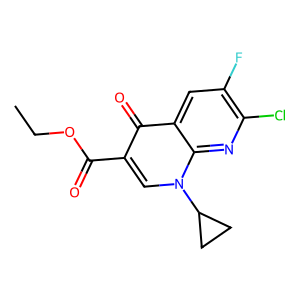 Cas:96568-07-9

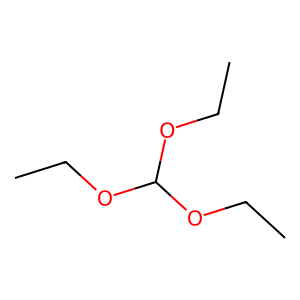 Cas:122-51-0

 Cas:765-30-0
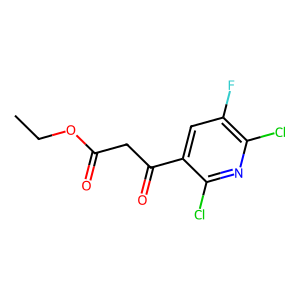 Cas:96568-04-6
 Cas:99735-36-1