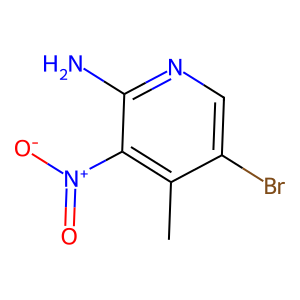
2-Amino-5-bromo-4-methyl-3-nitropyridine
Names and Identifiers of 100367-40-6
CAS Number |
100367-40-6 |
|---|---|
EC Number |
634-469-3 |
MDL Number |
MFCD00092197 |
IUPAC Name |
5-bromo-4-methyl-3-nitropyridin-2-amine |
InChI |
InChI=1S/C6H6BrN3O2/c1-3-4(7)2-9-6(8)5(3)10(11)12/h2H,1H3,(H2,8,9) |
InChIKey |
KFVGEPWMVKZPND-UHFFFAOYSA-N |
Canonical SMILES |
CC1=C(C(=NC=C1Br)N)[N+](=O)[O-] |
UNSPSC Code |
12352100 |
Physical and chemical properties of 100367-40-6
Acidity coefficient |
0.78±0.50(Predicted) |
|---|---|
Boiling Point |
314.1±37.0 °C at 760 mmHg |
Density |
1.8±0.1 g/cm3 |
Exact Mass |
230.964325 |
Flash Point |
143.8±26.5 °C |
Index of Refraction |
1.659 |
LogP |
3.25 |
Melting Point |
160-164ºC |
Molecular Formula |
C6H6BrN3O2 |
Molecular Weight |
232.035 |
PSA |
84.73000 |
Storage condition |
Refrigerator, Under Inert Atmosphere |
Vapour Pressure |
0.0±0.7 mmHg at 25°C |
Safety Information of 100367-40-6

Applications of 100367-40-6
This compound serves multiple roles in different fields:
- Pharmaceutical Intermediates: It is used in the synthesis of various pharmaceutical agents.
- Organic Synthesis: Its reactive functional groups make it valuable in constructing complex organic molecules.
- Research: It is utilized in laboratories for developing new chemical entities and studying reaction mechanisms.
Interaction Studies of 100367-40-6
Interaction studies involving 2-amino-5-bromo-4-methyl-3-nitropyridine focus on its reactivity with biological molecules and other chemical entities. Understanding these interactions can help elucidate its potential therapeutic roles or toxicity profiles. Preliminary studies suggest that its derivatives may interact with enzymes or receptors, but comprehensive data is still needed.
Biological Activity of 100367-40-6
Research indicates that 2-amino-5-bromo-4-methyl-3-nitropyridine exhibits biological activity, particularly as an intermediate in the synthesis of pharmaceutical compounds. Its structure allows it to interact with biological targets, although specific studies detailing its pharmacological effects remain limited. The compound's derivatives may possess antimicrobial or anticancer properties, warranting further investigation.
Physical sample testing spectrum (NMR) of 100367-40-6

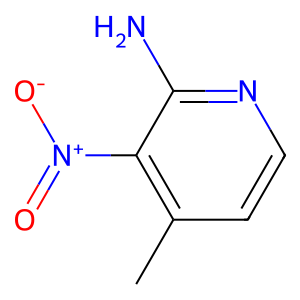 Cas:6635-86-5

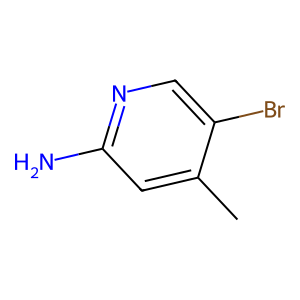 Cas:98198-48-2
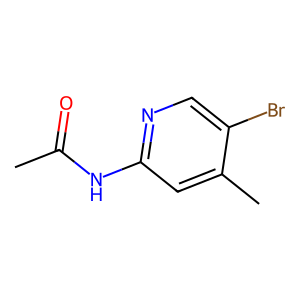 Cas:142404-82-8