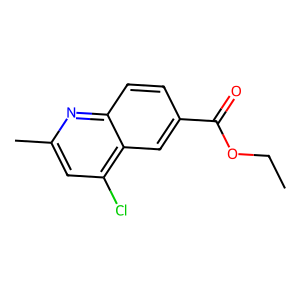
Ethyl 4-chloro-2-methylquinoline-6-carboxylate
CAS No.:
100375-87-9
M. Wt:
249.69300
M. Fa:
C13H12ClNO2
InChI Key:
WWHIKEAYZCGNRF-UHFFFAOYSA-N
Appearance:
Blue Solid
Names and Identifiers of 100375-87-9
CAS Number |
100375-87-9 |
|---|---|
EC Number |
873-451-1 |
MDL Number |
MFCD01143213 |
IUPAC Name |
ethyl 4-chloro-2-methylquinoline-6-carboxylate |
InChI |
InChI=1S/C13H12ClNO2/c1-3-17-13(16)9-4-5-12-10(7-9)11(14)6-8(2)15-12/h4-7H,3H2,1-2H3 |
InChIKey |
WWHIKEAYZCGNRF-UHFFFAOYSA-N |
Canonical SMILES |
CCOC(=O)C1=CC2=C(C=C(N=C2C=C1)C)Cl |
UNSPSC Code |
12352100 |
Physical and chemical properties of 100375-87-9
Acidity coefficient |
3.49±0.50(Predicted) |
|---|---|
Boiling Point |
355.4ºC at 760 mmHg |
Density |
1.252 g/cm3 |
Exact Mass |
249.05600 |
Flash Point |
168.7ºC |
LogP |
3.37330 |
Melting Point |
113-114 °C |
Molecular Formula |
C13H12ClNO2 |
Molecular Weight |
249.69300 |
PSA |
39.19000 |
Storage condition |
under inert gas (nitrogen or Argon) at 2-8°C |
Safety Information of 100375-87-9

Applications of 100375-87-9
Ethyl 4-chloro-2-methylquinoline-6-carboxylate has several applications, including:
- Pharmaceutical Industry: As a building block for synthesizing bioactive compounds, particularly in drug discovery focused on antimicrobial and anticancer agents.
- Chemical Research: Used as a reagent in organic synthesis for developing new materials or compounds with desired properties.
Interaction Studies of 100375-87-9
Interaction studies involving ethyl 4-chloro-2-methylquinoline-6-carboxylate typically focus on its behavior in biological systems. These studies may include:
- Binding Affinity Studies: Assessing how well this compound interacts with specific biological targets (e.g., enzymes or receptors).
- Toxicological Assessments: Evaluating its safety profile and potential side effects when used in biological applications.
Biological Activity of 100375-87-9
Research indicates that compounds related to ethyl 4-chloro-2-methylquinoline-6-carboxylate may exhibit significant biological activities, including:
- Antimicrobial Properties: Some studies suggest that derivatives of quinoline compounds possess antibacterial and antifungal activities, making them potential candidates for pharmaceutical development.
- Antiproliferative Effects: Certain quinoline derivatives have shown promise in inhibiting cancer cell proliferation, indicating potential use in oncology.
Physical sample testing spectrum (NMR) of 100375-87-9

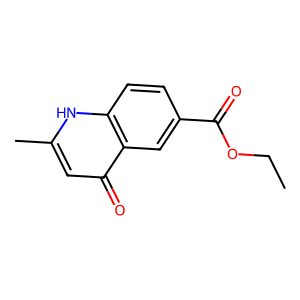 Cas:300590-94-7

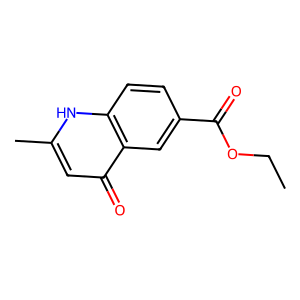 Cas:593287-13-9
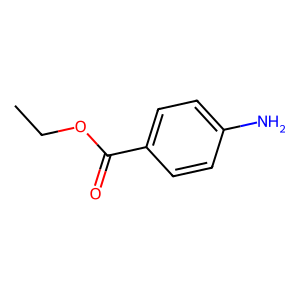 Cas:94-09-7