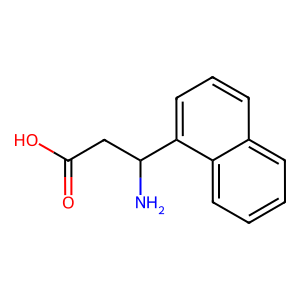
3-Amino-3-(naphthalen-1-yl)propanoic acid
Names and Identifiers of 100393-41-7
CAS Number |
100393-41-7 |
|---|---|
IUPAC Name |
3-amino-3-naphthalen-1-ylpropanoic acid |
InChI |
InChI=1S/C13H13NO2/c14-12(8-13(15)16)11-7-3-5-9-4-1-2-6-10(9)11/h1-7,12H,8,14H2,(H,15,16) |
InChIKey |
BIOQBKBTOAMMDG-UHFFFAOYSA-N |
Canonical SMILES |
C1=CC=C2C(=C1)C=CC=C2C(CC(=O)O)N |
Physical and chemical properties of 100393-41-7
Acidity coefficient |
3.41±0.12(Predicted) |
|---|---|
Boiling Point |
412.3ºC at 760mmHg |
Density |
1.252g/cm3 |
Exact Mass |
215.09500 |
Flash Point |
203.2ºC |
Index of Refraction |
1.658 |
LogP |
3.01460 |
Melting Point |
217-219ºC |
Molecular Formula |
C13H13NO2 |
Molecular Weight |
215.24800 |
PSA |
63.32000 |
Storage condition |
Keep in dark place,Inert atmosphere,Room temperature |
Vapour Pressure |
1.54E-07mmHg at 25°C |
Safety Information of 100393-41-7

Applications of 100393-41-7
3-Amino-3-(naphthalen-1-yl)propanoic acid has several applications across different fields:
- Pharmaceuticals: It is studied for its potential use as a neuroprotective agent and in treatments for neurological disorders.
- Biochemical Research: Used as a biochemical probe to study receptor interactions and signaling pathways in cellular systems.
- Material Science: Its unique chemical properties make it suitable for developing new materials with specific functionalities.
The versatility of this compound makes it valuable in both academic research and industrial applications.
Interaction Studies of 100393-41-7
Interaction studies have focused on the binding affinity of 3-Amino-3-(naphthalen-1-yl)propanoic acid with various biological targets, particularly neurotransmitter receptors. Preliminary findings suggest that it may exhibit competitive inhibition at certain receptor sites, indicating potential therapeutic implications. Further studies are needed to elucidate its mechanism of action and efficacy in vivo.
Biological Activity of 100393-41-7
Research indicates that 3-Amino-3-(naphthalen-1-yl)propanoic acid exhibits significant biological activity, particularly as a potential neuroprotective agent. Its structural similarity to neurotransmitters suggests it may interact with receptors in the central nervous system. Studies have shown that compounds with similar structures can modulate neurotransmitter systems, potentially offering therapeutic benefits for neurodegenerative diseases.
Physical sample testing spectrum (NMR) of 100393-41-7

 Cas:141-82-2

 Cas:66-77-3
