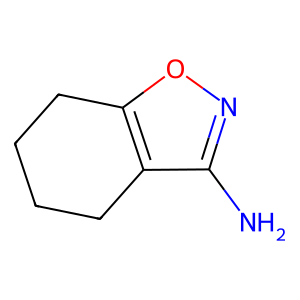
4,5,6,7-Tetrahydro-1,2-benzoxazol-3-amine
CAS No.:
1004-64-4
M. Wt:
138.16700
M. Fa:
C7H10N2O
InChI Key:
YTMJNWHCBGFYPZ-UHFFFAOYSA-N
Appearance:
Light Yellow To Yellow Solid
Names and Identifiers of 1004-64-4
CAS Number |
1004-64-4 |
|---|---|
EC Number |
861-437-8 |
MDL Number |
MFCD19205004 |
IUPAC Name |
4,5,6,7-tetrahydro-1,2-benzoxazol-3-amine |
InChI |
InChI=1S/C7H10N2O/c8-7-5-3-1-2-4-6(5)10-9-7/h1-4H2,(H2,8,9) |
InChIKey |
YTMJNWHCBGFYPZ-UHFFFAOYSA-N |
Canonical SMILES |
C1CCC2=C(C1)C(=NO2)N |
UNSPSC Code |
12352100 |
Physical and chemical properties of 1004-64-4
Exact Mass |
138.07900 |
|---|---|
LogP |
1.71680 |
Molecular Formula |
C7H10N2O |
Molecular Weight |
138.16700 |
PSA |
52.05000 |
Storage condition |
2-8°C |
Safety Information of 1004-64-4

Applications of 1004-64-4
The applications of 4,5,6,7-Tetrahydrobenzo[d]isoxazol-3-amine span various fields:
- Pharmaceutical Development: Utilized as a scaffold in drug design due to its biological activity.
- Chemical Research: Employed as a building block for synthesizing novel compounds with enhanced properties.
- Material Science: Investigated for potential use in developing new materials with unique characteristics.
Interaction Studies of 1004-64-4
Interaction studies of 4,5,6,7-Tetrahydrobenzo[d]isoxazol-3-amine focus on its binding affinity to various biological targets. These studies reveal:
- Enzyme Inhibition: The compound may inhibit specific enzymes involved in disease processes.
- Receptor Modulation: It can interact with neurotransmitter receptors, affecting signaling pathways related to neurological functions.
Such interactions are critical for understanding its mechanism of action and therapeutic potential.
Biological Activity of 1004-64-4
Research indicates that 4,5,6,7-Tetrahydrobenzo[d]isoxazol-3-amine possesses various biological activities. It has been studied for its potential:
- Antimicrobial Properties: Exhibiting activity against certain bacterial strains.
- Antiviral Effects: Showing promise in inhibiting viral replication.
- Anticancer Potential: Investigated for its ability to induce apoptosis in cancer cells through interaction with specific molecular targets.
These properties make it a candidate for therapeutic applications in treating infections and cancer.
Physical sample testing spectrum (NMR) of 1004-64-4

 Cas:4513-77-3
