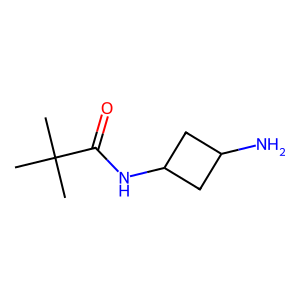
N-(3-Aminocyclobutyl)-2,2-dimethylpropanamide
Names and Identifiers of 1156752-37-2
CAS Number |
1156752-37-2 |
|---|---|
IUPAC Name |
N-(3-aminocyclobutyl)-2,2-dimethylpropanamide |
InChI |
InChI=1S/C9H18N2O/c1-9(2,3)8(12)11-7-4-6(10)5-7/h6-7H,4-5,10H2,1-3H3,(H,11,12) |
InChIKey |
ZVDKPCNKDHWBNN-UHFFFAOYSA-N |
Canonical SMILES |
CC(C)(C)C(=O)NC1CC(C1)N |
Physical and chemical properties of 1156752-37-2
Exact Mass |
170.14200 |
|---|---|
LogP |
2.17900 |
Molecular Formula |
C9H18N2O |
Molecular Weight |
170.25200 |
PSA |
58.61000 |
Safety Information of 1156752-37-2

Applications of 1156752-37-2
N-(3-Aminocyclobutyl)-2,2-dimethylpropanamide finds applications primarily in pharmaceutical research. Its role as a potential drug candidate for treating conditions like asthma and chronic obstructive pulmonary disease highlights its importance in medicinal chemistry. Furthermore, it may serve as a building block in the synthesis of more complex molecules with therapeutic potential.
Interaction Studies of 1156752-37-2
Studies on the interactions of N-(3-Aminocyclobutyl)-2,2-dimethylpropanamide with various biological macromolecules reveal its ability to modulate enzyme activity. This compound has shown promise in binding studies with phosphodiesterases, indicating its potential as a lead compound for drug development targeting these enzymes. Additionally, preliminary studies suggest interactions with neurotransmitter receptors, which could influence neurological pathways.
Biological Activity of 1156752-37-2
Research indicates that N-(3-Aminocyclobutyl)-2,2-dimethylpropanamide exhibits significant biological activity. It has been studied for its potential as a phosphodiesterase type 4 inhibitor, which could have implications in treating inflammatory diseases and other conditions where phosphodiesterase modulation is beneficial. Additionally, its structural properties suggest possible interactions with various biological targets, including enzymes and receptors involved in neurotransmission and inflammation.