
2,2-Dimethyl-4,7-dihydro-1,3-dioxepine
CAS No.:
1003-83-4
M. Wt:
128.169
M. Fa:
C7H12O2
InChI Key:
ATZGUXPLGMKHOR-UHFFFAOYSA-N
Appearance:
Colorless Liquid
Names and Identifiers of 2,2-Dimethyl-4,7-dihydro-1,3-dioxepine
CAS Number |
1003-83-4 |
|---|---|
EC Number |
445-850-7 |
MDL Number |
MFCD22054122 |
IUPAC Name |
2,2-dimethyl-4,7-dihydro-1,3-dioxepine |
InChI |
InChI=1S/C7H12O2/c1-7(2)8-5-3-4-6-9-7/h3-4H,5-6H2,1-2H3 |
InChIKey |
ATZGUXPLGMKHOR-UHFFFAOYSA-N |
Canonical SMILES |
CC1(OCC=CCO1)C |
UNII |
VBZ3ZAK4EJ |
UNSPSC Code |
12352100 |
Physical and chemical properties of 2,2-Dimethyl-4,7-dihydro-1,3-dioxepine
Boiling Point |
150.0±35.0 °C at 760 mmHg |
|---|---|
Density |
0.9±0.1 g/cm3 |
Exact Mass |
128.083725 |
Flash Point |
34.0±21.5 °C |
Index of Refraction |
1.424 |
LogP |
0.64 |
Molecular Formula |
C7H12O2 |
Molecular Weight |
128.169 |
PSA |
18.46000 |
Vapour Pressure |
5.0±0.3 mmHg at 25°C |
Safety Information of 2,2-Dimethyl-4,7-dihydro-1,3-dioxepine


Applications of 2,2-Dimethyl-4,7-dihydro-1,3-dioxepine
2,2-Dimethyl-4,7-dihydro-1,3-dioxepine finds applications in various fields:
- Pharmaceuticals: It serves as an important intermediate in the synthesis of drugs and bioactive compounds.
- Organic Synthesis: Its unique structure allows it to be used in the development of complex organic molecules.
- Material Science: Research into its properties may lead to applications in materials with specific chemical or physical characteristics .
Interaction Studies of 2,2-Dimethyl-4,7-dihydro-1,3-dioxepine
Studies on the interactions of 2,2-Dimethyl-4,7-dihydro-1,3-dioxepine with other compounds have highlighted its potential reactivity and compatibility with various reagents. For example:
- Reactivity with Copper Catalysts: The compound has been shown to effectively participate in copper-catalyzed reactions, indicating its utility in synthetic methodologies .
- Biological Interactions: Preliminary research suggests that derivatives of this compound may interact with biological targets relevant to medicinal chemistry .
Biological Activity of 2,2-Dimethyl-4,7-dihydro-1,3-dioxepine
The biological activity of 2,2-Dimethyl-4,7-dihydro-1,3-dioxepine has been explored in various studies. While specific pharmacological effects are not extensively documented, its derivatives have been noted for potential bioactivity. For instance, certain substituted dioxepines have demonstrated antimicrobial and anti-inflammatory properties. The mechanisms of action often relate to their ability to interact with biological targets through their heterocyclic structure .
Physical sample testing spectrum (NMR) of 2,2-Dimethyl-4,7-dihydro-1,3-dioxepine

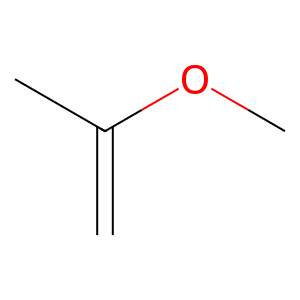 Cas:116-11-0

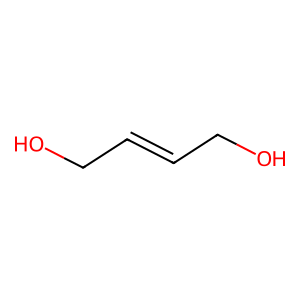 Cas:6117-80-2

 Cas:67-64-1