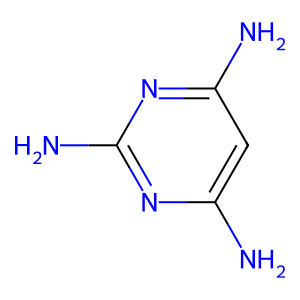
2,4,6-Triaminopyrimidine
Names and Identifiers of 2,4,6-Triaminopyrimidine
CAS Number |
1004-38-2 |
|---|---|
EC Number |
213-720-7 |
MDL Number |
MFCD00006100 |
IUPAC Name |
pyrimidine-2,4,6-triamine |
InChI |
InChI=1S/C4H7N5/c5-2-1-3(6)9-4(7)8-2/h1H,(H6,5,6,7,8,9) |
InChIKey |
JTTIOYHBNXDJOD-UHFFFAOYSA-N |
Canonical SMILES |
C1=C(N=C(N=C1N)N)N |
UNII |
D6ZP6F2ECK |
UNSPSC Code |
12352100 |
Physical and chemical properties of 2,4,6-Triaminopyrimidine
Acidity coefficient |
6.84(at 20℃) |
|---|---|
Boiling Point |
530.8±53.0 °C at 760 mmHg |
BRN |
118448 |
Density |
1.5±0.1 g/cm3 |
Exact Mass |
125.070145 |
Flash Point |
308.2±18.1 °C |
Index of Refraction |
1.793 |
LogP |
-1.01 |
Melting Point |
249-251 °C(lit.) |
Molecular Formula |
C4H7N5 |
Molecular Weight |
125.132 |
PSA |
103.84000 |
Storage condition |
Keep in dark place,Inert atmosphere,Room temperature |
Vapour Pressure |
0.0±1.4 mmHg at 25°C |
Water Solubility |
36.5 g/L (20 ºC) |
Safety Information of 2,4,6-Triaminopyrimidine

Applications of 2,4,6-Triaminopyrimidine
2,4,6-Triaminopyrimidine finds applications in several fields:
- Medicinal Chemistry: Its role as a potential drug candidate targeting specific enzymes makes it valuable in developing new pharmaceuticals.
- Materials Science: The compound is used in copolymerization processes to create materials with tailored properties.
- Biochemistry: Its structural similarity to nucleobases allows researchers to investigate its role in prebiotic chemistry and RNA synthesis.
Interaction Studies of 2,4,6-Triaminopyrimidine
Interaction studies have focused on how 2,4,6-triaminopyrimidine interacts with various biological molecules. For instance, its interactions with free radicals have been extensively studied to understand its antioxidant properties. The ability of this compound to stabilize or react with radical species suggests potential applications in protecting biological systems from oxidative damage.
Biological Activity of 2,4,6-Triaminopyrimidine
Research indicates that 2,4,6-triaminopyrimidine exhibits significant biological activity. It has been studied for its potential as an antitumor agent and as a selective inhibitor of phosphoinositide 3-kinase delta (PI3Kδ), which is crucial in various cellular processes including growth and metabolism. Furthermore, it shows promise in developing new therapeutic agents due to its ability to modulate biological pathways effectively.
Physical sample testing spectrum (NMR) of 2,4,6-Triaminopyrimidine

 Cas:1422426-90-1

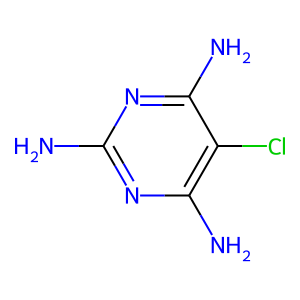 Cas:24867-23-0
 Cas:88075-69-8