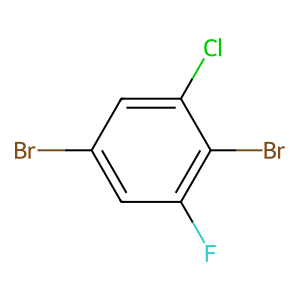
2,5-Dibromo-1-chloro-3-fluorobenzene
CAS No.:
1000572-88-2
M. Wt:
288.33900
M. Fa:
C6H2Br2ClF
InChI Key:
BNUYHYKELVQSHM-UHFFFAOYSA-N
Appearance:
Yellow Liquid
Names and Identifiers of 2,5-Dibromo-1-chloro-3-fluorobenzene
CAS Number |
1000572-88-2 |
|---|---|
MDL Number |
MFCD09878162 |
IUPAC Name |
2,5-dibromo-1-chloro-3-fluorobenzene |
InChI |
InChI=1S/C6H2Br2ClF/c7-3-1-4(9)6(8)5(10)2-3/h1-2H |
InChIKey |
BNUYHYKELVQSHM-UHFFFAOYSA-N |
Canonical SMILES |
C1=C(C=C(C(=C1F)Br)Cl)Br |
UNSPSC Code |
12352100 |
Physical and chemical properties of 2,5-Dibromo-1-chloro-3-fluorobenzene
Boiling Point |
248.3°C at 760 mmHg |
|---|---|
Exact Mass |
285.82000 |
LogP |
4.00410 |
Molecular Formula |
C6H2Br2ClF |
Molecular Weight |
288.33900 |
Storage condition |
Keep in dark place,Inert atmosphere,Room temperature |
Safety Information of 2,5-Dibromo-1-chloro-3-fluorobenzene

Applications of 2,5-Dibromo-1-chloro-3-fluorobenzene
2,5-Dibromo-1-chloro-3-fluorobenzene has a wide range of applications across different fields:
- Organic Synthesis: It serves as a crucial building block for synthesizing complex organic molecules, including pharmaceuticals and agrochemicals.
- Material Science: The compound is explored for its potential in developing new materials with unique properties due to its halogenated structure.
- Agrochemicals and Dyes: It is employed in producing various agrochemicals and dyes, leveraging its reactivity for functionalization.
Interaction Studies of 2,5-Dibromo-1-chloro-3-fluorobenzene
The interaction studies involving 2,5-Dibromo-1-chloro-3-fluorobenzene focus on its reactivity with nucleophiles and electrophiles:
- Nucleophilic Substitution Studies: Research has shown how the electron-withdrawing effects of its halogen substituents enhance nucleophilic substitution reactions, making it a valuable intermediate for synthesizing various derivatives.
- Protein-Ligand
Biological Activity of 2,5-Dibromo-1-chloro-3-fluorobenzene
The biological activity of 2,5-Dibromo-1-chloro-3-fluorobenzene has been explored in various contexts:
- Enzyme Inhibition Studies: The compound is utilized in studies investigating enzyme inhibition and protein-ligand interactions. Its halogenated structure can influence the binding affinity and specificity for certain biological targets.
- Potential Drug Development: As an intermediate in pharmaceutical synthesis, it may contribute to the development of new drug candidates targeting specific biological pathways.
Physical sample testing spectrum (NMR) of 2,5-Dibromo-1-chloro-3-fluorobenzene
