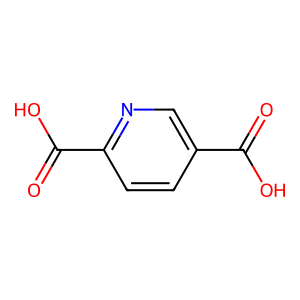
2,5-Pyridinedicarboxylic acid
CAS No.:
100-26-5
M. Wt:
167.12
M. Fa:
C7H5NO4
InChI Key:
LVPMIMZXDYBCDF-UHFFFAOYSA-N
Appearance:
White powder
Names and Identifiers of 2,5-Pyridinedicarboxylic acid
CAS Number |
100-26-5 |
|---|---|
EC Number |
202-834-2 |
MDL Number |
MFCD00006297 |
IUPAC Name |
pyridine-2,5-dicarboxylic acid |
InChI |
InChI=1S/C7H5NO4/c9-6(10)4-1-2-5(7(11)12)8-3-4/h1-3H,(H,9,10)(H,11,12) |
InChIKey |
LVPMIMZXDYBCDF-UHFFFAOYSA-N |
Canonical SMILES |
C1=CC(=NC=C1C(=O)O)C(=O)O |
UNII |
4K1KGR926X |
UNSPSC Code |
12352100 |
Physical and chemical properties of 2,5-Pyridinedicarboxylic acid
Acidity coefficient |
3.06±0.10(Predicted) |
|---|---|
Boiling Point |
441.1±30.0 °C at 760 mmHg |
BRN |
131697 |
Density |
1.6±0.1 g/cm3 |
Exact Mass |
167.021851 |
Flash Point |
220.5±24.6 °C |
Index of Refraction |
1.628 |
LogP |
-0.25 |
Melting Point |
242-247 °C (dec.)(lit.) |
Merck |
14,5159 |
Molecular Formula |
C7H5NO4 |
Molecular Weight |
167.12 |
PSA |
87.49000 |
Solubility |
1.2g/l |
Storage condition |
Inert atmosphere,2-8°C |
Vapour Pressure |
0.0000061 [mmHg] |
Water Solubility |
1.237g/L(25 ºC) |
Safety Information of 2,5-Pyridinedicarboxylic acid

Applications of 2,5-Pyridinedicarboxylic acid
The applications of 2,5-pyridinedicarboxylic acid span various fields:
- Pharmaceuticals: Its biological activity makes it a candidate for drug development.
- Agriculture: Potential use as a pesticide or herbicide due to its antimicrobial properties.
- Material Science: Employed in the synthesis of metal-organic frameworks for gas storage and separation applications.
- Analytical Chemistry: Used as a reagent in various analytical techniques.
Interaction Studies of 2,5-Pyridinedicarboxylic acid
Interaction studies have focused on the compound's ability to form complexes with various metal ions. These interactions are crucial for developing new materials with specific properties:
- Metal Complexes: Research has shown that 2,5-pyridinedicarboxylic acid can form stable complexes with transition metals such as palladium and lanthanides. These complexes exhibit unique luminescent properties and have potential applications in sensors and catalysis.
- Biological Interactions: Studies indicate that this compound may interact with biological macromolecules like proteins and nucleic acids, influencing their function and stability.
Biological Activity of 2,5-Pyridinedicarboxylic acid
Research indicates that 2,5-pyridinedicarboxylic acid exhibits several biological activities:
- Antioxidant Properties: It has been shown to scavenge free radicals, suggesting potential use in preventing oxidative stress-related diseases.
- Antimicrobial Activity: Some studies have reported its effectiveness against various bacterial strains, indicating potential applications in pharmaceuticals.
- Enzyme Inhibition: It may inhibit certain enzymes, which could be useful in drug design for treating diseases like cancer or metabolic disorders.
Physical sample testing spectrum (NMR) of 2,5-Pyridinedicarboxylic acid

 Cas:122-05-4

 Cas:2050-89-7

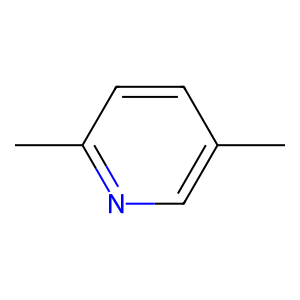 Cas:589-93-5
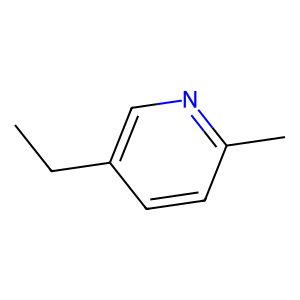 Cas:104-90-5