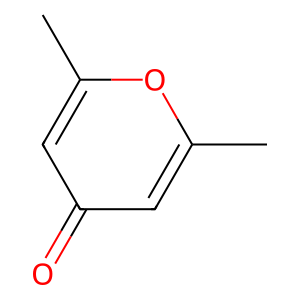
2,6-Dimethyl-4H-pyran-4-one
Names and Identifiers of 2,6-Dimethyl-4H-pyran-4-one
CAS Number |
1004-36-0 |
|---|---|
EC Number |
213-719-1 |
MDL Number |
MFCD00006579 |
IUPAC Name |
2,6-dimethylpyran-4-one |
InChI |
InChI=1S/C7H8O2/c1-5-3-7(8)4-6(2)9-5/h3-4H,1-2H3 |
InChIKey |
VSYFZULSKMFUJJ-UHFFFAOYSA-N |
Canonical SMILES |
CC1=CC(=O)C=C(O1)C |
UNII |
V2D262MF0L |
UNSPSC Code |
12352100 |
Physical and chemical properties of 2,6-Dimethyl-4H-pyran-4-one
Boiling Point |
249.0±0.0 °C at 760 mmHg |
|---|---|
BRN |
107418 |
Density |
1.1±0.1 g/cm3 |
Exact Mass |
124.052429 |
Flash Point |
103.4±12.3 °C |
Index of Refraction |
1.485 |
LogP |
0.10 |
Melting Point |
133-137 °C(lit.) |
Molecular Formula |
C7H8O2 |
Molecular Weight |
124.14 |
PSA |
30.21000 |
Storage condition |
Sealed in dry,Room Temperature |
Vapour Pressure |
0.0±0.5 mmHg at 25°C |
Water Solubility |
Slightly soluble in water. |
Safety Information of 2,6-Dimethyl-4H-pyran-4-one

Applications of 2,6-Dimethyl-4H-pyran-4-one
The applications of 2,6-Dimethyl-4H-pyran-4-one span multiple fields:
- Agriculture: It is used as an active ingredient in pesticides due to its biological activity against pests.
- Pharmaceuticals: Its antimicrobial properties make it useful in developing new medications.
- Flavoring Agents: The compound is also utilized in flavoring and fragrance formulations due to its pleasant aroma.
These diverse applications underscore the compound's significance in both industrial and research contexts.
Interaction Studies of 2,6-Dimethyl-4H-pyran-4-one
Studies on the interactions of 2,6-Dimethyl-4H-pyran-4-one with other chemical species have revealed insights into its reactivity and potential toxicity. For instance, investigations into its reaction pathways with phosgene provide valuable information regarding safety measures necessary when handling this compound in industrial settings.
Biological Activity of 2,6-Dimethyl-4H-pyran-4-one
Research indicates that 2,6-Dimethyl-4H-pyran-4-one exhibits significant biological activity. It has been noted for its potential antimicrobial properties, making it a candidate for use in pharmaceuticals and agricultural applications. Specific studies have shown that derivatives of this compound can inhibit the growth of certain bacteria and fungi.
Physical sample testing spectrum (NMR) of 2,6-Dimethyl-4H-pyran-4-one

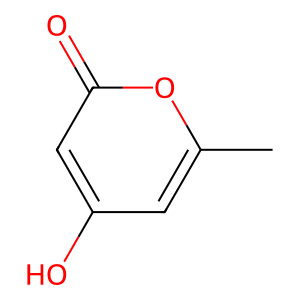 Cas:675-10-5

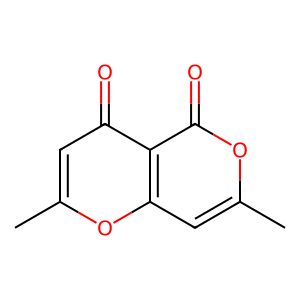 Cas:33176-11-3
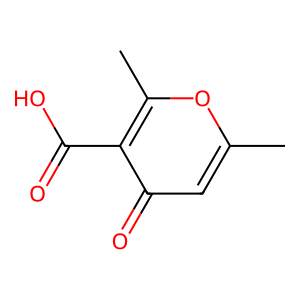 Cas:3265-58-5

 Cas:7647-01-0