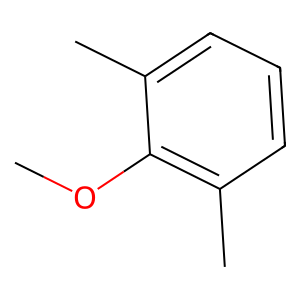
2,6-Dimethylanisole
CAS No.:
1004-66-6
M. Wt:
136.191
M. Fa:
C9H12O
InChI Key:
GFNZJAUVJCGWLW-UHFFFAOYSA-N
Appearance:
Colorless Liquid
Names and Identifiers of 2,6-Dimethylanisole
CAS Number |
1004-66-6 |
|---|---|
EC Number |
213-723-3 |
MDL Number |
MFCD00008380 |
IUPAC Name |
2-methoxy-1,3-dimethylbenzene |
InChI |
InChI=1S/C9H12O/c1-7-5-4-6-8(2)9(7)10-3/h4-6H,1-3H3 |
InChIKey |
GFNZJAUVJCGWLW-UHFFFAOYSA-N |
Canonical SMILES |
CC1=C(C(=CC=C1)C)OC |
UNSPSC Code |
12352100 |
Physical and chemical properties of 2,6-Dimethylanisole
Boiling Point |
181.0±9.0 °C at 760 mmHg |
|---|---|
BRN |
1858509 |
Density |
0.9±0.1 g/cm3 |
Exact Mass |
136.088821 |
Flash Point |
67.2±0.0 °C |
Index of Refraction |
1.495 |
LogP |
3.05 |
Molecular Formula |
C9H12O |
Molecular Weight |
136.191 |
PSA |
9.23000 |
Storage condition |
Sealed in dry,Room Temperature |
Vapour Pressure |
1.2±0.3 mmHg at 25°C |
Water Solubility |
Insoluble in water. |
Safety Information of 2,6-Dimethylanisole

Applications of 2,6-Dimethylanisole
2,6-Dimethylanisole finds applications across multiple industries:
- Fragrance Industry: It is used as a fragrance component due to its pleasant aroma.
- Flavoring Agent: The compound is utilized in food products for flavor enhancement.
- Chemical Intermediate: It serves as an intermediate in the synthesis of other organic compounds and pharmaceuticals.
Interaction Studies of 2,6-Dimethylanisole
Studies on the interactions of 2,6-dimethylanisole with other chemical species reveal its potential reactivity patterns. For instance:
- Aggregation Behavior: Research has explored the aggregation of lithium phenolate derivatives related to 2,6-dimethylanisole under various conditions, highlighting its behavior in different solvents and temperatures.
- Reactivity with Electrophiles: The compound's reactivity towards electrophiles has been extensively studied, providing insights into its application in synthetic organic chemistry.
Biological Activity of 2,6-Dimethylanisole
Research indicates that 2,6-dimethylanisole exhibits antimicrobial properties. Its derivatives have been studied for potential use in pharmaceuticals due to their ability to inhibit certain bacterial strains. The compound's structure allows it to interact favorably with biological systems, making it a candidate for further exploration in medicinal chemistry.
Physical sample testing spectrum (NMR) of 2,6-Dimethylanisole

 Cas:26620-08-6

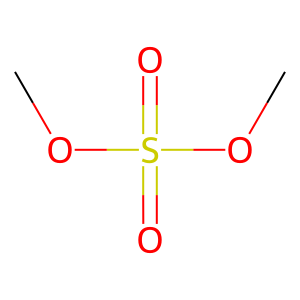 Cas:77-78-1

 Cas:34949-12-7
 Cas:74-88-4
 Cas:876-98-2