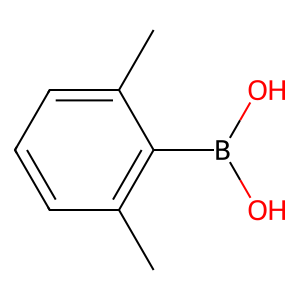
2,6-Dimethylphenylboronic acid
CAS No.:
100379-00-8
M. Wt:
149.98
M. Fa:
C8H11BO2
InChI Key:
ZXDTWWZIHJEZOG-UHFFFAOYSA-N
Appearance:
Solid
Names and Identifiers of 2,6-Dimethylphenylboronic acid
CAS Number |
100379-00-8 |
|---|---|
EC Number |
600-084-4 |
MDL Number |
MFCD01009693 |
IUPAC Name |
(2,6-dimethylphenyl)boronic acid |
InChI |
InChI=1S/C8H11BO2/c1-6-4-3-5-7(2)8(6)9(10)11/h3-5,10-11H,1-2H3 |
InChIKey |
ZXDTWWZIHJEZOG-UHFFFAOYSA-N |
Canonical SMILES |
B(C1=C(C=CC=C1C)C)(O)O |
UNSPSC Code |
12352100 |
Physical and chemical properties of 2,6-Dimethylphenylboronic acid
Acidity coefficient |
8.68±0.58(Predicted) |
|---|---|
Boiling Point |
299.9±50.0 °C at 760 mmHg |
Density |
1.1±0.1 g/cm3 |
Exact Mass |
150.085205 |
Flash Point |
135.2±30.1 °C |
Index of Refraction |
1.523 |
LogP |
2.51 |
Melting Point |
105 °C (dec.)(lit.) |
Molecular Formula |
C8H11BO2 |
Molecular Weight |
149.98 |
PSA |
40.46000 |
Solubility |
Soluble in methanol. |
Storage condition |
0-6°C |
Vapour Pressure |
0.0±0.7 mmHg at 25°C |
Safety Information of 2,6-Dimethylphenylboronic acid

Applications of 2,6-Dimethylphenylboronic acid
2,6-Dimethylphenylboronic acid finds extensive use in organic synthesis, particularly for:
- Suzuki-Miyaura Coupling: It serves as a key reagent for forming carbon-carbon bonds in pharmaceuticals and agrochemicals.
- Material Science: It is used in synthesizing polymers and materials that require precise control over molecular architecture.
- Analytical Chemistry: The compound can be employed in sensors for detecting specific biomolecules due to its ability to form complexes with diols.
Interaction Studies of 2,6-Dimethylphenylboronic acid
Research into the interaction of 2,6-dimethylphenylboronic acid with biological systems has revealed its potential to bind selectively to certain biomolecules. This property is particularly relevant in drug design, where boronic acids are being explored as inhibitors for enzymes such as serine proteases and glycosidases. These interactions are often characterized by their reversible nature, allowing for dynamic biological applications.
Physical sample testing spectrum (NMR) of 2,6-Dimethylphenylboronic acid

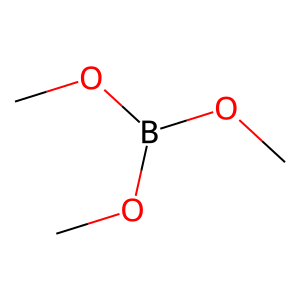 Cas:121-43-7

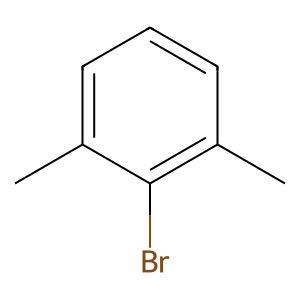 Cas:576-22-7

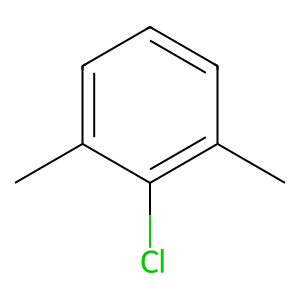 Cas:6781-98-2