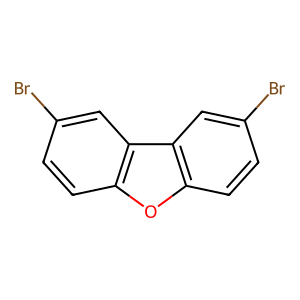
2,8-Dibromodibenzofuran
Names and Identifiers of 2,8-Dibromodibenzofuran
CAS Number |
10016-52-1 |
|---|---|
EC Number |
634-508-4 |
IUPAC Name |
2,8-dibromodibenzofuran |
InChI |
InChI=1S/C12H6Br2O/c13-7-1-3-11-9(5-7)10-6-8(14)2-4-12(10)15-11/h1-6H |
InChIKey |
UFCZRCPQBWIXTR-UHFFFAOYSA-N |
Canonical SMILES |
C1=CC2=C(C=C1Br)C3=C(O2)C=CC(=C3)Br |
Physical and chemical properties of 2,8-Dibromodibenzofuran
Boiling Point |
396.0±22.0 °C at 760 mmHg |
|---|---|
Density |
1.9±0.1 g/cm3 |
Exact Mass |
323.878540 |
Flash Point |
193.3±22.3 °C |
Index of Refraction |
1.739 |
LogP |
5.66 |
Melting Point |
195 °C |
Molecular Formula |
C12H6Br2O |
Molecular Weight |
325.983 |
PSA |
13.14000 |
Storage condition |
Sealed in dry,Room Temperature |
Vapour Pressure |
0.0±0.9 mmHg at 25°C |
Safety Information of 2,8-Dibromodibenzofuran

Applications of 2,8-Dibromodibenzofuran
2,8-Dibromodibenzofuran has applications primarily in research settings. It is used as a reference standard for environmental testing and analysis due to its classification as a persistent organic pollutant. Additionally, it serves as a precursor or building block in organic synthesis for developing other complex molecules, particularly in materials science where its properties may be exploited for creating novel materials.
Interaction Studies of 2,8-Dibromodibenzofuran
Interaction studies involving 2,8-dibromodibenzofuran focus on its reactivity with various biological molecules and environmental components. Research has shown that this compound can interact with proteins and nucleic acids, potentially leading to mutagenic effects. Furthermore, studies on its interactions with other environmental pollutants have revealed synergistic effects that could exacerbate toxicity levels in ecosystems.
Biological Activity of 2,8-Dibromodibenzofuran
Research indicates that 2,8-dibromodibenzofuran exhibits biological activity that may be relevant to toxicological studies. It has been associated with endocrine disruption and potential carcinogenic effects similar to other brominated compounds. The compound's structure allows it to interact with biological systems, potentially leading to adverse effects on health and the environment. Studies have highlighted its role in the formation of reactive intermediates that could contribute to toxicity.
Physical sample testing spectrum (NMR) of 2,8-Dibromodibenzofuran

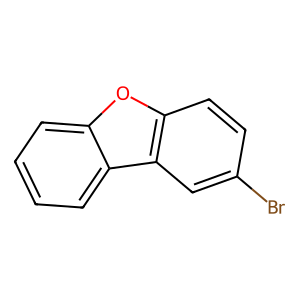 Cas:86-76-0

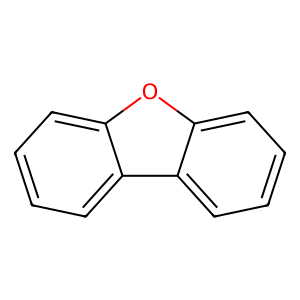 Cas:132-64-9
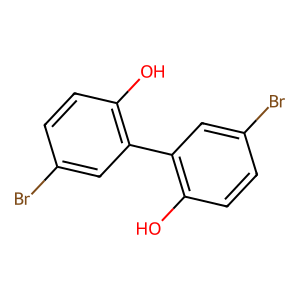 Cas:34261-55-7