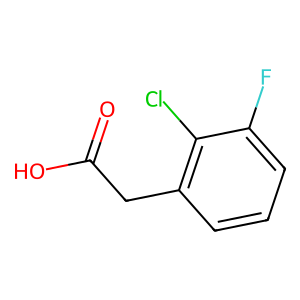
2-(2-Chloro-3-fluorophenyl)acetic acid
Names and Identifiers of 2-(2-Chloro-3-fluorophenyl)acetic acid
CAS Number |
1000523-07-8 |
|---|---|
MDL Number |
MFCD09925136 |
IUPAC Name |
2-(2-chloro-3-fluorophenyl)acetic acid |
InChI |
InChI=1S/C8H6ClFO2/c9-8-5(4-7(11)12)2-1-3-6(8)10/h1-3H,4H2,(H,11,12) |
InChIKey |
JNMBDAACHFCAKX-UHFFFAOYSA-N |
Canonical SMILES |
C1=CC(=C(C(=C1)F)Cl)CC(=O)O |
UNSPSC Code |
12352100 |
Physical and chemical properties of 2-(2-Chloro-3-fluorophenyl)acetic acid
Acidity coefficient |
3.85±0.10(Predicted) |
|---|---|
Boiling Point |
293.1±25.0 °C(Predicted) |
Density |
1.417±0.06 g/cm3(Predicted) |
Exact Mass |
188.00400 |
LogP |
2.10620 |
Molecular Formula |
C8H6ClFO2 |
Molecular Weight |
188.58300 |
PSA |
37.30000 |
Storage condition |
Sealed in dry,Room Temperature |
Safety Information of 2-(2-Chloro-3-fluorophenyl)acetic acid

Applications of 2-(2-Chloro-3-fluorophenyl)acetic acid
2-(2-Chloro-3-fluorophenyl)acetic acid has several applications:
- Pharmaceuticals: Its potential as an anti-inflammatory agent positions it as a candidate for drug development.
- Chemical Research: It serves as a building block for synthesizing more complex organic molecules.
- Agricultural Chemicals: The compound may also find use in developing herbicides or pesticides due to its unique chemical properties.
Interaction Studies of 2-(2-Chloro-3-fluorophenyl)acetic acid
Studies on the interactions of 2-(2-Chloro-3-fluorophenyl)acetic acid with biological molecules have shown that it can bind to various receptors involved in inflammatory responses. Its unique halogen substituents enhance its binding affinity, which is crucial for its therapeutic potential. Investigations into its mechanism of action reveal that it may modulate signaling pathways associated with pain perception and inflammation.
Biological Activity of 2-(2-Chloro-3-fluorophenyl)acetic acid
Research indicates that 2-(2-Chloro-3-fluorophenyl)acetic acid exhibits notable biological activity. It has been studied for its potential anti-inflammatory and analgesic properties, making it a candidate for drug development. The specific arrangement of the chlorine and fluorine atoms on the phenyl ring enhances its interaction with biological targets, potentially affecting signaling pathways related to pain and inflammation.
Physical sample testing spectrum (NMR) of 2-(2-Chloro-3-fluorophenyl)acetic acid
