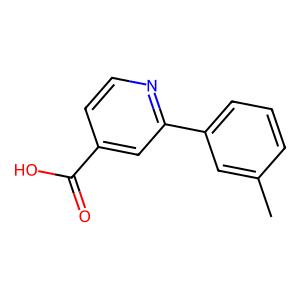
2-(3-Methylphenyl)isonicotinic acid
Names and Identifiers of 2-(3-Methylphenyl)isonicotinic acid
CAS Number |
100004-94-2 |
|---|---|
MDL Number |
MFCD14666477 |
IUPAC Name |
2-(3-methylphenyl)pyridine-4-carboxylic acid |
InChI |
InChI=1S/C13H11NO2/c1-9-3-2-4-10(7-9)12-8-11(13(15)16)5-6-14-12/h2-8H,1H3,(H,15,16) |
InChIKey |
IAIXMJKQOKCRSW-UHFFFAOYSA-N |
Canonical SMILES |
CC1=CC(=CC=C1)C2=NC=CC(=C2)C(=O)O |
UNSPSC Code |
12352100 |
Physical and chemical properties of 2-(3-Methylphenyl)isonicotinic acid
Exact Mass |
213.07900 |
|---|---|
H Bond Acceptors |
3 |
H Bond Donors |
1 |
LogP |
2.75520 |
Molecular Formula |
C13H11NO2 |
Molecular Weight |
213.23200 |
PSA |
50.19000 |
Storage condition |
Sealed in dry,Room Temperature |
Safety Information of 2-(3-Methylphenyl)isonicotinic acid

Applications of 2-(3-Methylphenyl)isonicotinic acid
2-(M-tolyl)isonicotinic acid finds numerous applications in various fields:
- Pharmaceuticals: It serves as an intermediate in the synthesis of drug candidates targeting bacterial infections.
- Organic Synthesis: The compound acts as a versatile building block for creating more complex organic molecules.
- Material Science: It may be used in developing advanced materials due to its unique chemical properties.
Interaction Studies of 2-(3-Methylphenyl)isonicotinic acid
Studies on the interactions of 2-(M-tolyl)isonicotinic acid with biological systems reveal its potential mechanisms of action. The presence of the m-tolyl group may enhance its affinity for certain enzymes or receptors, thereby modulating their activity. Research into these interactions helps elucidate the compound's role in metabolic pathways and its efficacy in therapeutic applications.
Biological Activity of 2-(3-Methylphenyl)isonicotinic acid
The biological activity of 2-(M-tolyl)isonicotinic acid is linked to its structural similarity to isoniazid, a well-known antitubercular agent. As a derivative, it may exhibit antimicrobial properties by interfering with bacterial cell wall synthesis. The compound's interaction with specific biological targets enhances its potential as a therapeutic agent in treating infections caused by Mycobacterium tuberculosis. Additionally, its unique electronic properties due to the m-tolyl group may influence its binding affinity to various enzymes and receptors.
Physical sample testing spectrum (NMR) of 2-(3-Methylphenyl)isonicotinic acid

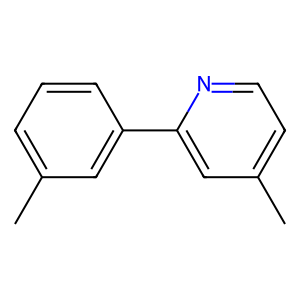 Cas:80635-91-2

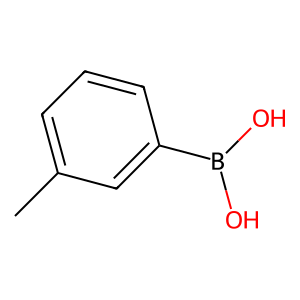 Cas:17933-03-8
 Cas:108-44-1