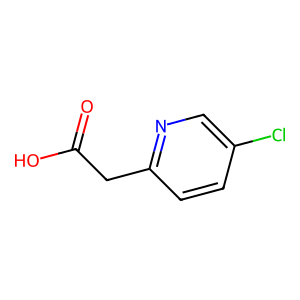
2-(5-Chloropyridin-2-yl)acetic acid
Names and Identifiers of 2-(5-Chloropyridin-2-yl)acetic acid
CAS Number |
1000522-43-9 |
|---|---|
EC Number |
826-295-3 |
MDL Number |
MFCD09925072 |
IUPAC Name |
2-(5-chloropyridin-2-yl)acetic acid |
InChI |
InChI=1S/C7H6ClNO2/c8-5-1-2-6(9-4-5)3-7(10)11/h1-2,4H,3H2,(H,10,11) |
InChIKey |
AUCKAGADUXSVKT-UHFFFAOYSA-N |
Canonical SMILES |
C1=CC(=NC=C1Cl)CC(=O)O |
UNSPSC Code |
12352100 |
Physical and chemical properties of 2-(5-Chloropyridin-2-yl)acetic acid
Acidity coefficient |
3.81±0.10(Predicted) |
|---|---|
Boiling Point |
295.9±25.0 °C at 760 mmHg |
Density |
1.4±0.1 g/cm3 |
Exact Mass |
171.008713 |
Flash Point |
132.8±23.2 °C |
Index of Refraction |
1.575 |
LogP |
0.86 |
Molecular Formula |
C7H6ClNO2 |
Molecular Weight |
171.581 |
PSA |
50.19000 |
Storage condition |
under inert gas (nitrogen or Argon) at 2-8°C |
Vapour Pressure |
0.0±0.7 mmHg at 25°C |
Safety Information of 2-(5-Chloropyridin-2-yl)acetic acid

Applications of 2-(5-Chloropyridin-2-yl)acetic acid
2-(5-Chloropyridin-2-yl)acetic acid has various applications, particularly in medicinal chemistry:
- Pharmaceutical Development: It is used as a building block for synthesizing biologically active compounds.
- Research Tool: Its derivatives are employed in studying receptor interactions and biological pathways.
- Agricultural Chemistry: Potential use in developing agrochemicals due to its biological activity.
Interaction Studies of 2-(5-Chloropyridin-2-yl)acetic acid
Interaction studies involving 2-(5-Chloropyridin-2-yl)acetic acid focus on its binding affinity to various biological targets. Preliminary studies suggest that it may interact with specific receptors, influencing signaling pathways related to metabolic and physiological processes. These interactions are critical for understanding its pharmacological profile and potential therapeutic uses .
Biological Activity of 2-(5-Chloropyridin-2-yl)acetic acid
Research indicates that 2-(5-Chloropyridin-2-yl)acetic acid exhibits notable biological activities. It has been studied for its potential as an agonist for certain receptors, which could make it useful in treating various conditions. Additionally, its structural features suggest possible interactions with biological targets, making it a candidate for further pharmacological studies. The specific mechanisms of action and therapeutic effects are subjects of ongoing research.
Physical sample testing spectrum (NMR) of 2-(5-Chloropyridin-2-yl)acetic acid
