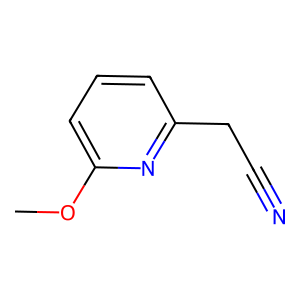
2-(6-Methoxypyridin-2-yl)acetonitrile
Names and Identifiers of 2-(6-Methoxypyridin-2-yl)acetonitrile
CAS Number |
1000512-48-0 |
|---|---|
MDL Number |
MFCD09923742 |
IUPAC Name |
2-(6-methoxypyridin-2-yl)acetonitrile |
InChI |
InChI=1S/C8H8N2O/c1-11-8-4-2-3-7(10-8)5-6-9/h2-4H,5H2,1H3 |
InChIKey |
XNYIRHWBNGDYPU-UHFFFAOYSA-N |
Canonical SMILES |
COC1=CC=CC(=N1)CC#N |
UNSPSC Code |
12352100 |
Physical and chemical properties of 2-(6-Methoxypyridin-2-yl)acetonitrile
Acidity coefficient |
1.34±0.12(Predicted) |
|---|---|
Boiling Point |
255.2ºC at 760 mmHg |
Density |
1.115 g/cm3 |
Exact Mass |
148.06400 |
Flash Point |
108.2ºC |
LogP |
1.15628 |
Molecular Formula |
C8H8N2O |
Molecular Weight |
148.16200 |
PSA |
45.91000 |
Storage condition |
2-8°C |
Safety Information of 2-(6-Methoxypyridin-2-yl)acetonitrile

Applications of 2-(6-Methoxypyridin-2-yl)acetonitrile
The applications of 2-(6-Methoxypyridin-2-yl)acetonitrile span several fields:
- Pharmaceutical Industry: As a building block for synthesizing new drugs targeting various diseases.
- Agricultural Chemicals: Potential use as a pesticide or herbicide due to its biological activity.
- Material Science: Investigated for use in developing new materials with specific properties due to its unique chemical structure.
Interaction Studies of 2-(6-Methoxypyridin-2-yl)acetonitrile
Interaction studies involving 2-(6-Methoxypyridin-2-yl)acetonitrile focus on its binding affinity and activity against various biological targets:
- Enzyme Inhibition Studies: Evaluating how effectively it inhibits specific enzymes related to disease pathways.
- Receptor Binding Assays: Investigating interactions with neurotransmitter receptors and their implications for neurological therapies.
- Cell Culture Experiments: Assessing cytotoxicity and efficacy in cancer cell lines to determine therapeutic potential.
These studies are crucial for understanding the compound's mechanisms and optimizing its applications.
Similar CompoundsSeveral compounds share structural features with 2-(6-Methoxypyridin-2-yl)acetonitrile, providing insights into its uniqueness:
| Compound Name | Structure Features | Unique Aspects |
|---|---|---|
| 6-Methylpyridine | Pyridine ring with methyl substitution | Lacks the acetonitrile functionality |
| 5-(Methoxy)pyridine | Methoxy group at position 5 | Different position of substitution |
| 2-(Pyridin-2-yl)acetonitrile | Pyridine without methoxy substitution | Does not possess methoxy functionality |
| 4-(Methoxypyridin-3-yl)acetonitrile | Methoxy at position 4 | Variation in position affects biological activity |
Biological Activity of 2-(6-Methoxypyridin-2-yl)acetonitrile
Research indicates that 2-(6-Methoxypyridin-2-yl)acetonitrile exhibits notable biological activities, particularly in pharmacological applications. It has been studied for its potential as:
- Antimicrobial Agent: Exhibiting activity against various bacterial strains.
- Anticancer Properties: Some derivatives have shown promise in inhibiting cancer cell proliferation.
- Neurological Effects: Potential interactions with neurotransmitter systems have been explored, suggesting possible applications in treating neurological disorders.
The specific mechanisms of action are still under investigation, but they may involve modulation of enzyme activity or interaction with cellular receptors.
Physical sample testing spectrum (NMR) of 2-(6-Methoxypyridin-2-yl)acetonitrile
