
2-(Boc-amino)-2-cyclopropylethanol
Names and Identifiers of 2-(Boc-amino)-2-cyclopropylethanol
CAS Number |
1001414-89-6 |
|---|---|
EC Number |
895-696-3 |
IUPAC Name |
tert-butyl N-[(1R)-1-cyclopropyl-2-hydroxyethyl]carbamate |
InChI |
InChI=1S/C10H19NO3/c1-10(2,3)14-9(13)11-8(6-12)7-4-5-7/h7-8,12H,4-6H2,1-3H3,(H,11,13)/t8-/m0/s1 |
InChIKey |
FRRCSAZNGYCTLR-QMMMGPOBSA-N |
Canonical SMILES |
CC(C)(C)OC(=O)NC(CO)C1CC1 |
Isomeric SMILES |
CC(C)(C)OC(=O)N[C@@H](CO)C1CC1 |
Physical and chemical properties of 2-(Boc-amino)-2-cyclopropylethanol
Boiling Point |
321.7±25.0 °C(Predicted) |
|---|---|
Exact Mass |
201.13600 |
LogP |
1.67290 |
Molecular Formula |
C10H19NO3 |
Molecular Weight |
201.26300 |
PSA |
58.56000 |
Safety Information of 2-(Boc-amino)-2-cyclopropylethanol

Applications of 2-(Boc-amino)-2-cyclopropylethanol
Tert-butyl N-[(1R)-1-cyclopropyl-2-hydroxyethyl]carbamate has several applications in scientific research, particularly in:
- Drug Development: As a potential anticancer agent targeting CK2.
- Synthetic Chemistry: Serving as an intermediate in the synthesis of other bioactive compounds.
Due to its unique structure, it may also be utilized in studies related to enzyme inhibition and molecular interactions within biological systems.
Interaction Studies of 2-(Boc-amino)-2-cyclopropylethanol
Interaction studies have focused on the binding affinity of tert-butyl N-[(1R)-1-cyclopropyl-2-hydroxyethyl]carbamate with various biological targets. Its mechanism of action involves hydrogen bonding and steric interactions facilitated by the tert-butyl and hydroxyl groups, which influence the reactivity and binding profiles of the compound. Such studies are crucial for understanding its potential therapeutic effects and optimizing its efficacy as an inhibitor.
Biological Activity of 2-(Boc-amino)-2-cyclopropylethanol
This compound has been studied for its biological activity, particularly as a potential inhibitor of casein kinase 2 (CK2), an enzyme implicated in various cellular processes and overexpressed in certain cancers. As such, tert-butyl N-[(1R)-1-cyclopropyl-2-hydroxyethyl]carbamate has garnered interest in cancer research due to its selective inhibition properties, which may lead to therapeutic applications in oncology.
Physical sample testing spectrum (NMR) of 2-(Boc-amino)-2-cyclopropylethanol

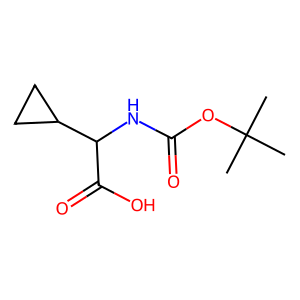 Cas:155976-13-9

 Cas:1270290-36-2

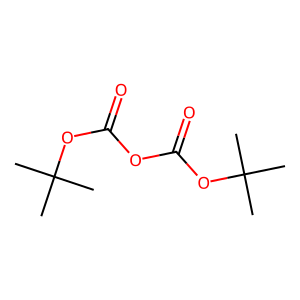 Cas:24424-99-5