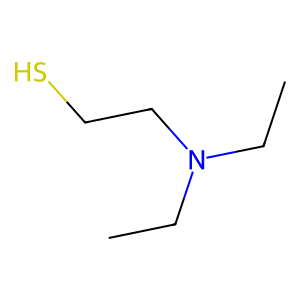
2-(Diethylamino)ethanethiol
CAS No.:
100-38-9
M. Wt:
133.255
M. Fa:
C6H15NS
InChI Key:
YBDSNEVSFQMCTL-UHFFFAOYSA-N
Names and Identifiers of 2-(Diethylamino)ethanethiol
CAS Number |
100-38-9 |
|---|---|
EC Number |
202-846-8 |
IUPAC Name |
2-(diethylamino)ethanethiol |
InChI |
InChI=1S/C6H15NS/c1-3-7(4-2)5-6-8/h8H,3-6H2,1-2H3 |
InChIKey |
YBDSNEVSFQMCTL-UHFFFAOYSA-N |
Canonical SMILES |
CCN(CC)CCS |
UNII |
TF6S7Q84YD |
Physical and chemical properties of 2-(Diethylamino)ethanethiol
Boiling Point |
161.6±23.0 °C at 760 mmHg |
|---|---|
Density |
0.9±0.1 g/cm3 |
Exact Mass |
133.092514 |
Flash Point |
51.5±22.6 °C |
Index of Refraction |
1.469 |
LogP |
1.82 |
Melting Point |
127-129 °C(lit.) |
Molecular Formula |
C6H15NS |
Molecular Weight |
133.255 |
PSA |
42.04000 |
Vapour Pressure |
2.3±0.3 mmHg at 25°C |
Safety Information of 2-(Diethylamino)ethanethiol


Applications of 2-(Diethylamino)ethanethiol
2-(Diethylamino)ethanethiol finds applications in various fields:
- Chemical Synthesis: It serves as a reagent in organic synthesis, particularly in the modification of polymers and the production of thioether compounds.
- Pharmaceuticals: Its derivatives are explored for potential therapeutic applications due to their biological activity.
- Chemical Research: Used as a model compound in studies related to electrochemistry and reaction mechanisms involving thiols.
Interaction Studies of 2-(Diethylamino)ethanethiol
Studies have investigated the interactions of 2-(Diethylamino)ethanethiol with various substrates and biological systems. For example:
- Electrochemical Behavior: Research has focused on its oxidation processes, revealing insights into its reactivity and stability under different conditions.
- Biological Interactions: Investigations into its neurotoxic properties have highlighted potential risks associated with exposure, particularly in contexts related to chemical warfare agents.
These studies contribute to understanding how this compound behaves in both synthetic and biological environments.
Biological Activity of 2-(Diethylamino)ethanethiol
Research indicates that 2-(Diethylamino)ethanethiol may exhibit biological activity relevant to pharmacology and toxicology. It is noted as a precursor for compounds that can affect neurotransmitter systems and has been studied for its potential neurotoxic effects related to nerve agents. The compound's ability to interact with biological systems makes it significant in both medicinal chemistry and toxicological studies.
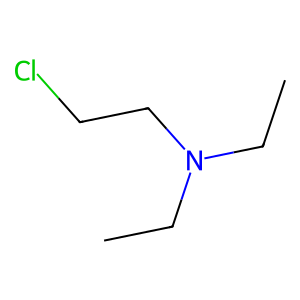 Cas:100-35-6

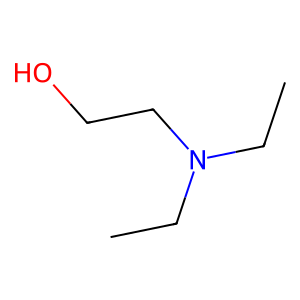 Cas:100-37-8
 Cas:64-17-5

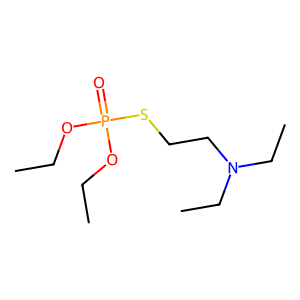 Cas:78-53-5