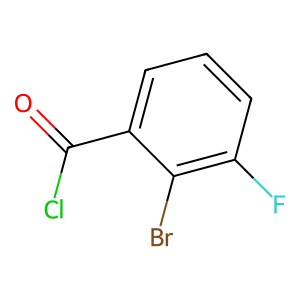
2-Bromo-3-fluorobenzoyl chloride
Names and Identifiers of 2-Bromo-3-fluorobenzoyl chloride
CAS Number |
1000339-91-2 |
|---|---|
MDL Number |
MFCD09864686 |
IUPAC Name |
2-bromo-3-fluorobenzoyl chloride |
InChI |
InChI=1S/C7H3BrClFO/c8-6-4(7(9)11)2-1-3-5(6)10/h1-3H |
InChIKey |
BIDXHLMXMWMYJC-UHFFFAOYSA-N |
Canonical SMILES |
O=C(Cl)C1=CC=CC(F)=C1Br |
UNSPSC Code |
12352100 |
Physical and chemical properties of 2-Bromo-3-fluorobenzoyl chloride
Exact Mass |
235.90400 |
|---|---|
LogP |
2.96720 |
Molecular Formula |
C7H3BrClFO |
Molecular Weight |
237.45400 |
PSA |
17.07000 |
Safety Information of 2-Bromo-3-fluorobenzoyl chloride

Applications of 2-Bromo-3-fluorobenzoyl chloride
2-Bromo-3-fluorobenzoyl chloride finds applications in various fields:
- Pharmaceutical intermediates: The compound serves as a building block in the synthesis of potential drug candidates, particularly those requiring halogenated aromatic moieties.
- Agrochemical synthesis: It can be used in the preparation of novel pesticides and herbicides.
- Material science: The compound may be employed in the development of specialty polymers and advanced materials.
- Organic synthesis: As a versatile reagent, it is utilized in the preparation of complex organic molecules and natural product analogues.
Interaction Studies of 2-Bromo-3-fluorobenzoyl chloride
While specific interaction studies for 2-Bromo-3-fluorobenzoyl chloride are not readily available, similar compounds have been investigated for their interactions with various biological targets. The presence of halogen substituents can influence binding affinity and selectivity towards proteins and enzymes. Further research is needed to elucidate the specific interactions of this compound with biological systems.
Similar CompoundsSeveral compounds share structural similarities with 2-Bromo-3-fluorobenzoyl chloride:
- 2-Bromo-3-chloro-5-fluorobenzoyl chloride: This compound has an additional chlorine substituent at the 5-position, potentially altering its reactivity and physical properties.
- 2-Fluorobenzoyl chloride: Lacking the bromine substituent, this compound is structurally simpler but retains similar reactivity of the carbonyl chloride group.
- 3-Fluorobenzoyl chloride: An isomer of 2-fluorobenzoyl chloride, with the fluorine in a different position on the aromatic ring.
- 2-Bromobenzoyl chloride: This compound lacks the fluorine substituent but retains the bromine at the 2-position.
The uniqueness of 2-Bromo-3-fluorobenzoyl chloride lies in its specific substitution pattern, combining both bromine and fluorine on the aromatic ring. This arrangement can confer distinct electronic and steric properties, potentially influencing its reactivity and applications in organic synthesis and medicinal chemistry.
Biological Activity of 2-Bromo-3-fluorobenzoyl chloride
While specific biological activity data for 2-Bromo-3-fluorobenzoyl chloride is limited, compounds containing similar structural features have shown various biological effects. The presence of halogen substituents (bromine and fluorine) on the aromatic ring can influence the compound's lipophilicity and metabolic stability, potentially affecting its interactions with biological systems.
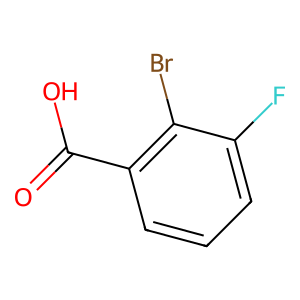 Cas:132715-69-6

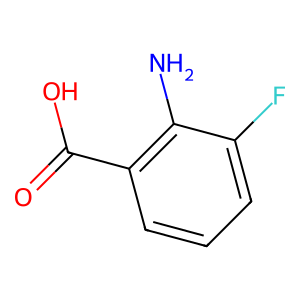 Cas:825-22-9
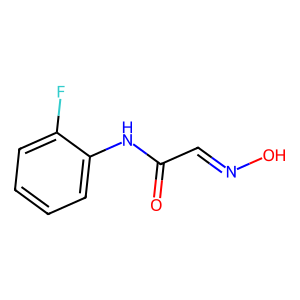 Cas:349-24-6