
2-Bromo-4-fluoroaniline
Names and Identifiers of 2-Bromo-4-fluoroaniline
CAS Number |
1003-98-1 |
|---|---|
EC Number |
619-469-3 |
MDL Number |
MFCD00042462 |
IUPAC Name |
2-bromo-4-fluoroaniline |
InChI |
InChI=1S/C6H5BrFN/c7-5-3-4(8)1-2-6(5)9/h1-3H,9H2 |
InChIKey |
YLMFXCIATJJKQL-UHFFFAOYSA-N |
Canonical SMILES |
C1=CC(=C(C=C1F)Br)N |
UNSPSC Code |
12352100 |
Physical and chemical properties of 2-Bromo-4-fluoroaniline
Acidity coefficient |
2.60±0.10(Predicted) |
|---|---|
Boiling Point |
221.0±0.0 °C at 760 mmHg |
BRN |
2802562 |
Density |
1.7±0.1 g/cm3 |
Exact Mass |
188.958939 |
Flash Point |
104.4±0.0 °C |
Index of Refraction |
1.597 |
LogP |
2.40 |
Melting Point |
41 |
Molecular Formula |
C6H5BrFN |
Molecular Weight |
190.013 |
PSA |
26.02000 |
Storage condition |
Keep in dark place,Inert atmosphere,Room temperature |
Vapour Pressure |
0.1±0.4 mmHg at 25°C |
Safety Information of 2-Bromo-4-fluoroaniline

Applications of 2-Bromo-4-fluoroaniline
2-Bromo-4-fluoroaniline serves multiple applications:
- Pharmaceuticals: It is used as an intermediate in the synthesis of various drugs due to its ability to modify biological activity.
- Agrochemicals: The compound is also explored for use in designing pesticides or herbicides that target specific biological pathways.
- Dyes and Pigments: Its unique structure allows for potential applications in dye manufacturing, particularly in creating fluorescent compounds.
Interaction Studies of 2-Bromo-4-fluoroaniline
Interaction studies involving 2-bromo-4-fluoroaniline focus on its reactivity with biological molecules. Research indicates that this compound can interact with proteins and nucleic acids, affecting their function. For example, studies have shown that similar compounds can inhibit certain enzymes or modulate receptor activity, suggesting that 2-bromo-4-fluoroaniline may exhibit comparable interactions.
Biological Activity of 2-Bromo-4-fluoroaniline
2-Bromo-4-fluoroaniline exhibits various biological activities, making it a subject of interest in medicinal chemistry. Studies indicate that compounds with similar structures may possess antimicrobial, antifungal, or anticancer properties. The presence of both bromine and fluorine atoms can enhance lipophilicity, potentially increasing cellular uptake and bioavailability. Additionally, its derivatives have been explored for their effects on enzyme inhibition and receptor binding.
Physical sample testing spectrum (NMR) of 2-Bromo-4-fluoroaniline

 Cas:371-40-4

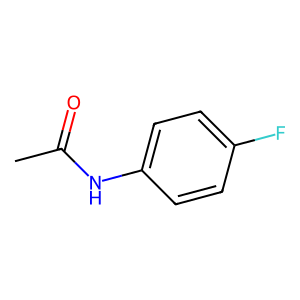 Cas:351-83-7