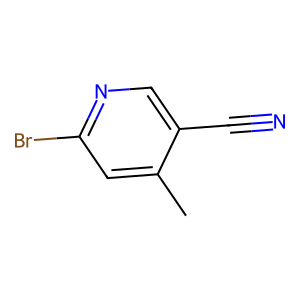
2-Bromo-5-cyano-4-picoline
Names and Identifiers of 2-Bromo-5-cyano-4-picoline
CAS Number |
1003711-35-0 |
|---|---|
MDL Number |
MFCD09839265 |
IUPAC Name |
6-bromo-4-methylpyridine-3-carbonitrile |
InChI |
InChI=1S/C7H5BrN2/c1-5-2-7(8)10-4-6(5)3-9/h2,4H,1H3 |
InChIKey |
DHUDYHHQMIRPHS-UHFFFAOYSA-N |
Canonical SMILES |
CC1=CC(=NC=C1C#N)Br |
UNSPSC Code |
12352100 |
Physical and chemical properties of 2-Bromo-5-cyano-4-picoline
Acidity coefficient |
-2.00±0.18(Predicted) |
|---|---|
Boiling Point |
287.9±35.0 °C at 760 mmHg |
Density |
1.6±0.1 g/cm3 |
Exact Mass |
195.963608 |
Flash Point |
127.9±25.9 °C |
Index of Refraction |
1.594 |
LogP |
1.76 |
Molecular Formula |
C7H5BrN2 |
Molecular Weight |
197.032 |
PSA |
36.68000 |
Storage condition |
2-8°C |
Vapour Pressure |
0.0±0.6 mmHg at 25°C |
Safety Information of 2-Bromo-5-cyano-4-picoline

Applications of 2-Bromo-5-cyano-4-picoline
2-Bromo-5-cyano-4-picoline has diverse applications across various fields:
- Chemistry: Serves as a building block for synthesizing more complex organic molecules.
- Biology: Investigated for potential interactions with biomolecules.
- Medicine: Explored as a precursor in pharmaceutical synthesis.
- Industry: Utilized in producing agrochemicals, dyes, and other industrial chemicals.
Interaction Studies of 2-Bromo-5-cyano-4-picoline
The interaction studies of 2-Bromo-5-cyano-4-picoline focus on its ability to engage with enzymes, receptors, and other biomolecules. The presence of the bromine and cyano groups enhances its reactivity, allowing it to form derivatives that may exhibit specific biological activities. These interactions are crucial for understanding its mechanism of action and potential therapeutic applications.
Biological Activity of 2-Bromo-5-cyano-4-picoline
Research indicates that 2-Bromo-5-cyano-4-picoline exhibits potential biological activities, particularly in medicinal chemistry. Its structure allows it to interact with various biological targets, making it a candidate for further investigation in pharmacological studies. Its derivatives may have applications in treating diseases due to their ability to modulate biological pathways.
Physical sample testing spectrum (NMR) of 2-Bromo-5-cyano-4-picoline
