
2-Bromothiophene
CAS No.:
1003-09-4
M. Wt:
163.036
M. Fa:
C4H3BrS
InChI Key:
TUCRZHGAIRVWTI-UHFFFAOYSA-N
Appearance:
Colorless to Light yellow to Light orange clear li
Names and Identifiers of 2-Bromothiophene
CAS Number |
1003-09-4 |
|---|---|
EC Number |
213-699-4 |
MDL Number |
MFCD00005417 |
IUPAC Name |
2-bromothiophene |
InChI |
InChI=1S/C4H3BrS/c5-4-2-1-3-6-4/h1-3H |
InChIKey |
TUCRZHGAIRVWTI-UHFFFAOYSA-N |
Canonical SMILES |
C1=CSC(=C1)Br |
UNII |
GFF929NUW7 |
UNSPSC Code |
12352100 |
Physical and chemical properties of 2-Bromothiophene
Boiling Point |
150.0±0.0 °C at 760 mmHg |
|---|---|
BRN |
104663 |
Density |
1.7±0.1 g/cm3 |
Exact Mass |
161.913879 |
Flash Point |
47.1±19.8 °C |
Index of Refraction |
1.595 |
LogP |
2.75 |
Melting Point |
-10 °C |
Molecular Formula |
C4H3BrS |
Molecular Weight |
163.036 |
PSA |
28.24000 |
Sensitivity |
Light Sensitive |
Storage condition |
2-8°C |
Vapour Pressure |
5.0±0.2 mmHg at 25°C |
Water Solubility |
IMMISCIBLE |
Solubility of 2-Bromothiophene
| Solvent | Dissolution Behavior | Temperature Effect | pH Effect |
|---|---|---|---|
| Water | Almost insoluble, forms oily layers | Increased temperature slightly enhances solubility, but remains very low | No significant effect, due to molecular stability and non-ionization |
| Ethanol | Readily soluble, forms colorless transparent solution | Solubility increases with rising temperature | No noticeable effect |
| Diethyl ether | Readily soluble, good miscibility | Increased temperature promotes dissolution | No effect |
| Dichloromethane | Completely miscible, commonly used solvent | Solubility remains stable or slightly increases with temperature rise | No effect |
| Acetone | Readily soluble, can mix in any proportion | Solubility slightly improves with increasing temperature | No significant effect |
| n-Hexane | Soluble, but lower solubility compared to polar organic solvents | Heating facilitates dissolution | No effect |
| Toluene | Readily soluble, frequently used as an organic reaction solvent | Increased temperature significantly enhances solubility | No effect |
Routine testing items of 2-Bromothiophene
| Test Item | Common Testing Methods | Method Summary |
|---|---|---|
| Appearance | Visual Inspection | Observe the color, physical state, and presence of mechanical impurities in the sample under natural light or standard illumination. |
| Assay (Purity) | Gas Chromatography (GC) | Use a capillary gas chromatograph to determine the purity of 2-bromothiophene by comparing retention times and peak areas with those of a reference standard. Typically employs an FID detector. |
| Bromine Content | Elemental Analysis (EA) or Ion Chromatography | Determine organic bromine content via combustion-absorption titration or elemental analyzer to verify whether the actual bromine content matches the theoretical value. |
| Moisture Content | Karl Fischer Titration | Precisely measure trace water content based on the reaction of iodine and sulfur dioxide with water in an anhydrous environment. |
| Residual Solvents | Gas Chromatography (GC) | Detect organic solvents possibly remaining from manufacturing (e.g., toluene, ethanol) according to pharmacopoeial or relevant standards (e.g., ICH Q3C). |
| Related Substances (Impurities) | High-Performance Liquid Chromatography (HPLC) or Gas Chromatography (GC) | Separate and detect organic impurities in 2-bromothiophene (e.g., thiophene, 3-bromothiophene, dibrominated compounds), assessing impurity profile and total impurity levels. |
| Melting Point / Boiling Point | Melting Point Apparatus or Boiling Point Determination | Measure physical constants to assist in evaluating compound purity and consistency (2-bromothiophene is a liquid, so boiling point or refractive index is typically measured). |
| Refractive Index (n20D) | Refractometry | Measure refractive index at 20°C as a parameter for identity confirmation and purity assessment of liquid organic compounds. |
| Density | Pycnometer Method or Oscillating U-tube Density Meter | Measure mass per unit volume to verify product consistency. |
| Structural Confirmation | Nuclear Magnetic Resonance (NMR), Mass Spectrometry (MS), Infrared Spectroscopy (IR) | Use a combination of 1H-NMR, 13C-NMR, GC-MS or LC-MS, and FT-IR to confirm molecular structure. |
Safety Information of 2-Bromothiophene


Key Milestone of 2-Bromothiophene
| Year | Event Description | Significance and Impact |
|---|---|---|
| Late 19th to early 20th century | Thiophene compounds were first systematically studied and synthesized by chemists | The thiophene structure was confirmed as a fundamental aromatic heterocyclic skeleton, laying the foundation for the synthesis of subsequent derivatives (e.g., 2-bromothiophene). |
| 1930s–1940s | 2-Bromothiophene was successfully prepared from thiophene via bromination reactions for the first time | Selective bromination at the α-position (2-position) of thiophene was achieved, marking the formal synthesis and characterization of 2-bromothiophene. This method typically used bromine or NBS (N-bromosuccinimide) in the presence of a catalyst. |
| 1950s–1960s | 2-Bromothiophene was used as an organic synthesis intermediate in reactions such as Grignard and coupling reactions | It became an important precursor for building complex thiophene derivatives, demonstrating initial value in pharmaceutical and materials chemistry. |
| 1970s | With the development of transition metal catalytic reactions, 2-bromothiophene was employed in cross-coupling reactions like Suzuki and Stille | It played a key role in constructing conjugated organic semiconducting materials, driving its application in electronic materials fields. |
| 1980s–1990s | It was widely used in the synthesis of biologically active thiophene-based drug molecules | As a key intermediate, it participated in the development of anti-inflammatory, antibacterial, and antitumor drugs, including certain COX-2 inhibitors and kinase inhibitors in their synthetic routes. |
| 2000s | Broadly applied in organic optoelectronic materials, particularly in synthesizing conductive polythiophene polymers | 2-Bromothiophene served as a monomer or coupling unit for preparing OLEDs, organic field-effect transistors (OFETs), and organic solar cell materials. |
| 2010s to present | Green synthesis and efficient catalytic transformation processes have been optimized | More environmentally friendly bromination methods (e.g., catalytic selective bromination) and recycling technologies have been developed, with improved efficiency in continuous flow chemistry applications. |
| Present day (2020s) | Has become an important building block molecule in pharmaceuticals, agrochemicals, and functional materials | Multiple global chemical companies have achieved large-scale production, supplying it widely to both research and industrial sectors. It is now an indispensable Building Block in modern organic synthesis. |
Applications of 2-Bromothiophene
2-Bromothiophene finds applications across various fields:
- Organic Synthesis: It serves as an important intermediate for synthesizing pharmaceuticals, agrochemicals, and materials.
- Material Science: The compound is used in the development of conductive polymers and dyes due to its electronic properties.
- Research: It is utilized as a building block in synthetic chemistry for developing new compounds with potential biological activities.
Biological Activity of 2-Bromothiophene
Research indicates that 2-bromothiophene exhibits notable biological activity. Some studies have shown that derivatives of thiophenes possess antimicrobial properties, and compounds similar to 2-bromothiophene have been investigated for their potential as anti-cancer agents. The biological activity often correlates with structural modifications made to the thiophene ring, suggesting that 2-bromothiophene could serve as a lead compound for further pharmacological development.
Physical sample testing spectrum (NMR) of 2-Bromothiophene

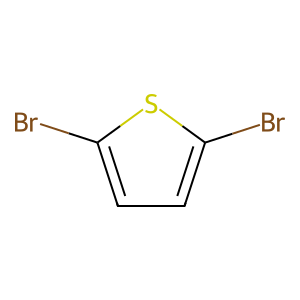 Cas:3141-27-3

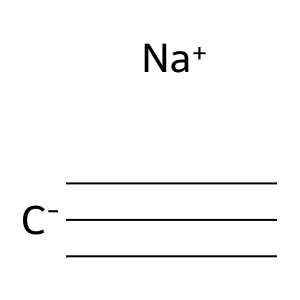 Cas:1066-26-8

 Cas:7664-41-7
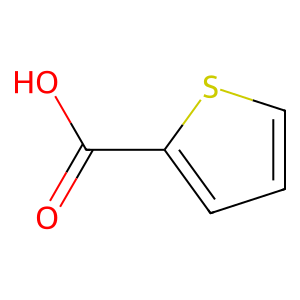 Cas:527-72-0
 Cas:623-11-0
 Cas:7726-95-6