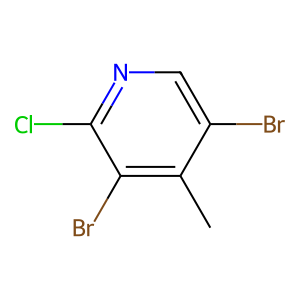
2-Chloro-3,5-dibromo-4-methylpyridine
CAS No.:
1000017-92-4
M. Wt:
285.364
M. Fa:
C6H4Br2ClN
InChI Key:
PFKZKCIYLRBYBZ-UHFFFAOYSA-N
Appearance:
White Solid
Names and Identifiers of 2-Chloro-3,5-dibromo-4-methylpyridine
CAS Number |
1000017-92-4 |
|---|---|
EC Number |
874-564-9 |
MDL Number |
MFCD09864796 |
IUPAC Name |
3,5-dibromo-2-chloro-4-methylpyridine |
InChI |
InChI=1S/C6H4Br2ClN/c1-3-4(7)2-10-6(9)5(3)8/h2H,1H3 |
InChIKey |
PFKZKCIYLRBYBZ-UHFFFAOYSA-N |
Canonical SMILES |
CC1=C(C(=NC=C1Br)Cl)Br |
UNSPSC Code |
12352100 |
Physical and chemical properties of 2-Chloro-3,5-dibromo-4-methylpyridine
Acidity coefficient |
-2.21±0.10(Predicted) |
|---|---|
Boiling Point |
285.1±35.0 °C at 760 mmHg |
Density |
2.0±0.1 g/cm3 |
Exact Mass |
282.839874 |
Flash Point |
126.2±25.9 °C |
Index of Refraction |
1.607 |
LogP |
3.71 |
Molecular Formula |
C6H4Br2ClN |
Molecular Weight |
285.364 |
PSA |
12.89000 |
Storage condition |
2-8°C |
Vapour Pressure |
0.0±0.6 mmHg at 25°C |
Safety Information of 2-Chloro-3,5-dibromo-4-methylpyridine

Applications of 2-Chloro-3,5-dibromo-4-methylpyridine
2-Chloro-3,5-dibromo-4-methylpyridine has several applications:
- Pharmaceutical Intermediate: It serves as an intermediate in the synthesis of various pharmaceuticals due to its reactive halogen substituents.
- Agricultural Chemicals: This compound may be used in the development of agrochemicals for pest control.
- Material Science: Its ability to participate in coupling reactions makes it valuable in creating new materials with specific properties.
Interaction Studies of 2-Chloro-3,5-dibromo-4-methylpyridine
Interaction studies involving 2-chloro-3,5-dibromo-4-methylpyridine focus on its reactivity with various nucleophiles and electrophiles. Investigations into its interactions with metal catalysts during coupling reactions reveal its potential utility in synthetic organic chemistry. Additionally, studies examining its biological interactions suggest possible pathways for drug development.
Physical sample testing spectrum (NMR) of 2-Chloro-3,5-dibromo-4-methylpyridine
