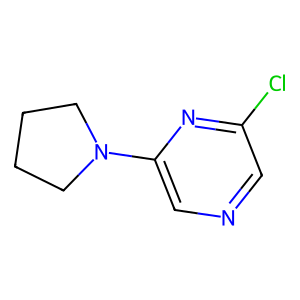
2-Chloro-6-(pyrrolidin-1-yl)pyrazine
Names and Identifiers of 2-Chloro-6-(pyrrolidin-1-yl)pyrazine
CAS Number |
1000339-30-9 |
|---|---|
MDL Number |
MFCD09864953 |
IUPAC Name |
2-chloro-6-pyrrolidin-1-ylpyrazine |
InChI |
InChI=1S/C8H10ClN3/c9-7-5-10-6-8(11-7)12-3-1-2-4-12/h5-6H,1-4H2 |
InChIKey |
JWMYNAAPKTUCSM-UHFFFAOYSA-N |
Canonical SMILES |
C1CCN(C1)C2=CN=CC(=N2)Cl |
UNSPSC Code |
12352100 |
Physical and chemical properties of 2-Chloro-6-(pyrrolidin-1-yl)pyrazine
Boiling Point |
310.211ºC at 760 mmHg |
|---|---|
Density |
1.475g/cm3 |
Exact Mass |
183.05600 |
Flash Point |
141.411ºC |
Index of Refraction |
1.702 |
LogP |
1.79520 |
Molecular Formula |
C8H10ClN3 |
Molecular Weight |
183.63800 |
PSA |
29.02000 |
Storage condition |
2-8°C |
Vapour Pressure |
0.001mmHg at 25°C |
Safety Information of 2-Chloro-6-(pyrrolidin-1-yl)pyrazine

Applications of 2-Chloro-6-(pyrrolidin-1-yl)pyrazine
The primary applications of 2-Chloro-6-(pyrrolidin-1-yl)pyrazine include:
- Pharmaceutical Development: Its role as a protein kinase modulator makes it valuable in drug discovery for treating cancers and other diseases linked to kinase activity.
- Chemical Research: It serves as an intermediate in synthesizing other complex organic molecules and compounds used in medicinal chemistry.
- Agricultural Chemicals: Potential applications in developing agrochemicals due to its biological activity against specific pests or pathogens.
Interaction Studies of 2-Chloro-6-(pyrrolidin-1-yl)pyrazine
Interaction studies involving 2-Chloro-6-(pyrrolidin-1-yl)pyrazine have focused on its effects on various biological targets. These studies often utilize biochemical assays to evaluate how the compound influences kinase activity or interacts with cellular pathways. The findings indicate that it may selectively inhibit certain kinases, thereby altering downstream signaling processes crucial for cell proliferation and survival.
Biological Activity of 2-Chloro-6-(pyrrolidin-1-yl)pyrazine
Research indicates that 2-Chloro-6-(pyrrolidin-1-yl)pyrazine exhibits significant biological activity, particularly as a modulator of protein kinases. Protein kinases are critical in various cellular processes, including signal transduction and cell division. The compound's ability to influence these pathways suggests potential applications in therapeutic contexts, especially in cancer research and treatment.
 Cas:123-75-1

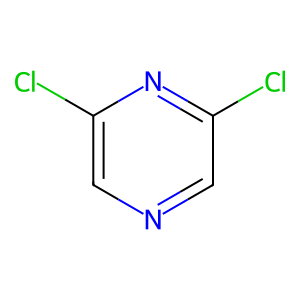 Cas:4774-14-5
