
2-Chloroheptane
CAS No.:
1001-89-4
M. Wt:
134.64700
M. Fa:
C7H15Cl
InChI Key:
PTSLUOSUHFGQHV-UHFFFAOYSA-N
Appearance:
Colorless to Almost colorless clear liquid
Names and Identifiers of 2-Chloroheptane
CAS Number |
1001-89-4 |
|---|---|
EC Number |
213-683-7 |
IUPAC Name |
2-chloroheptane |
InChI |
InChI=1S/C7H15Cl/c1-3-4-5-6-7(2)8/h7H,3-6H2,1-2H3 |
InChIKey |
PTSLUOSUHFGQHV-UHFFFAOYSA-N |
Canonical SMILES |
CCCCCC(C)Cl |
Physical and chemical properties of 2-Chloroheptane
Boiling Point |
150ºC at 760mmHg |
|---|---|
Density |
0.864g/cm3 |
Exact Mass |
134.08600 |
Flash Point |
39.2ºC |
Index of Refraction |
1.418 |
LogP |
3.19400 |
Melting Point |
-69.5°C (estimate) |
Molecular Formula |
C7H15Cl |
Molecular Weight |
134.64700 |
Vapour Pressure |
5mmHg at 25°C |
Safety Information of 2-Chloroheptane


Applications of 2-Chloroheptane
2-Chloroheptane serves various roles in chemical synthesis and industrial applications:
- Solvent: It is commonly used as a solvent in organic reactions due to its ability to dissolve a wide range of organic compounds.
- Intermediate in Organic Synthesis: It plays a crucial role as an intermediate in the synthesis of pharmaceuticals and agrochemicals.
- Chemical Research: Its reactivity makes it useful for studying reaction mechanisms involving haloalkanes.
Interaction Studies of 2-Chloroheptane
Interaction studies involving 2-chloroheptane primarily focus on its reactivity with nucleophiles and its behavior in various chemical environments. Research indicates that it can undergo nucleophilic attack by hydroxide ions, leading to substitution products. Additionally, studies have explored its interactions with biological membranes due to its lipophilic nature, which could influence its toxicity profile and environmental behavior.
Physical sample testing spectrum (NMR) of 2-Chloroheptane

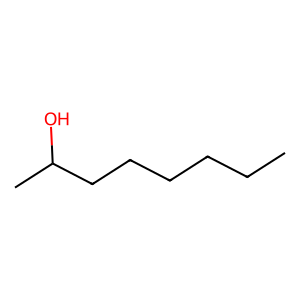 Cas:123-96-6

 Cas:762-46-9
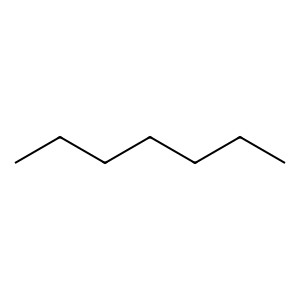 Cas:142-82-5