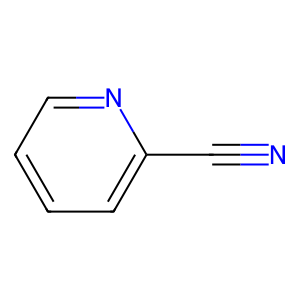
2-Cyanopyridine
Names and Identifiers of 2-Cyanopyridine
CAS Number |
100-70-9 |
|---|---|
EC Number |
202-880-3 |
MDL Number |
MFCD00006218 |
IUPAC Name |
pyridine-2-carbonitrile |
InChI |
InChI=1S/C6H4N2/c7-5-6-3-1-2-4-8-6/h1-4H |
InChIKey |
FFNVQNRYTPFDDP-UHFFFAOYSA-N |
Canonical SMILES |
C1=CC=NC(=C1)C#N |
UNII |
WHR1DPG7YS |
UNSPSC Code |
12352100 |
Physical and chemical properties of 2-Cyanopyridine
Acidity coefficient |
pK1:-0.26(+1) (25°C) |
|---|---|
Boiling Point |
224.5 °C |
BRN |
107710 |
Density |
1.0810 @ 25 °C |
Exact Mass |
104.037445 |
Exposure Limits |
NIOSH: IDLH 25 mg/m3 |
Flash Point |
89.4±0.0 °C |
Index of Refraction |
Index of refraction: 1.5242 @ 25 °C/D |
LogP |
log Kow= 0.45 |
Melting Point |
29 °C |
Molecular Formula |
C6H4N2 |
Molecular Weight |
104.109 |
pH |
8.4 (100g/l, H2O) |
PSA |
36.68000 |
Solubility |
Soluble in chloroform; slightly soluble in petroleum ether. |
Storage condition |
2-8°C |
Vapour Pressure |
0.09 [mmHg] |
Water Solubility |
immiscible |
Solubility of 2-Cyanopyridine
| Solvent | Dissolution Behavior | Temperature Effect | pH Effect |
|---|---|---|---|
| Water | Slightly soluble (~1.5 g/100 mL, 20°C) | Solubility increases slightly with rising temperature | Stable solubility under acidic or neutral conditions; may undergo hydrolysis under alkaline conditions, reducing solubility |
| Ethanol | Highly soluble (miscible) | Solubility increases significantly with rising temperature | Relatively unaffected, but decomposition may occur under strong alkaline conditions |
| Methanol | Highly soluble (miscible) | Solubility increases with rising temperature | Good stability; may react under extreme pH conditions |
| Acetone | Highly soluble (miscible) | Increased temperature enhances solubility | Stable under acidic or basic conditions, but slow hydrolysis may occur under strong base |
| Diethyl ether | Slightly to moderately soluble (partial dissolution) | Solubility improves slightly with increasing temperature | Unstable; prone to side reactions under alkaline conditions |
| Chloroform | Highly soluble (miscible) | Solubility increases with temperature | Stable under acidic or neutral conditions; may decompose under strong base |
| Dichloromethane | Highly soluble (miscible) | Solubility increases with temperature | Relatively stable, but potential reaction risk under strong alkaline conditions |
| Ethyl acetate | Soluble (partial dissolution) | Solubility increases with temperature | Stable under acidic conditions; may undergo slow hydrolysis under alkaline conditions |
| Benzene | Sluggishly soluble (low solubility) | Solubility improves slightly with increasing temperature | Stable under neutral conditions; may react under strong alkaline conditions |
| Dimethylbenzene (Xylene) | Sluggishly soluble (low solubility) | Solubility increases slightly with temperature | Good stability, but possible decomposition at high temperatures under strong alkali |
Safety Information of 2-Cyanopyridine

Key Milestone of 2-Cyanopyridine
| Year | Event | Description | Significance / Impact |
|---|---|---|---|
| 1901 | First Synthesis Reported | German chemist Wilhelm Borsche first synthesized 2-cyanopyridine while studying pyridine derivatives, via a reaction between pyridine N-oxide and phosphoryl trichloride (POCl₃) with cyanide compounds. | Marked the confirmation of the compound's chemical existence, laying the foundation for future research. |
| 1930s–1940s | Optimization of Synthetic Methods | Multiple synthetic routes were developed, including the introduction of the cyano group into 2-aminopyridine through diazotization-Sandmeyer reaction. | Improved yield and reproducibility, promoting its use as an organic synthetic intermediate. |
| 1950s | Initial Application as Pharmaceutical Intermediate | Began to be used in synthesizing biologically active nitrogen-containing heterocycles, such as precursors for antihistamines and vitamin B3 (niacin) derivatives. | Demonstrated its potential in medicinal chemistry. |
| 1960s–1970s | Expansion into Pesticide Applications | Used in the synthesis of various pyridine-based herbicides and insecticides, including intermediates for certain nicotinic compounds. | Expanded its industrial applications in agrochemicals. |
| 1980s | Fine Chemicals and Ligand Research | 2-Cyanopyridine was employed as a precursor for metal ligands; via hydrolysis or reduction, it could be converted into 2-pyridinecarboxylic acid, 2-aminomethylpyridine, etc., applied in catalysis and materials science. | Advanced its application in coordination chemistry and functional materials. |
| 1990s–2000s | Key Intermediate in Pharmaceutical Industry | Became a crucial building block in the synthesis of numerous blockbuster drugs, such as antihypertensive agents (e.g., nifedipine analogs), antiviral drugs, and kinase inhibitors. | Consolidated its central role in modern drug development. |
| 2010s–Present | Green Synthesis and Sustainable Processes | More environmentally friendly synthetic pathways were developed, such as using non-cyanide reagents and catalytic cyanation reactions (e.g., transition-metal-catalyzed C–H cyanation), reducing toxic waste. | Aligned with green chemistry principles, enhancing the sustainability of industrial production. |
| 2020s | Exploration of Emerging Applications | Currently being investigated as a functional monomer in organic optoelectronic materials, covalent organic frameworks (COFs), and metal-organic frameworks (MOFs). | Highlighted its potential in advanced materials science. |
Applications of 2-Cyanopyridine
The applications of 2-cyanopyridine are diverse:
- Pharmaceutical Intermediates: It is widely used in the synthesis of pharmaceutical compounds, including bronchodilators and other therapeutic agents.
- Bioconjugation: The compound's ability to selectively react with thiols makes it valuable for bioconjugation techniques in peptide chemistry and drug design.
- Chemical Research: Its role as a precursor in various organic syntheses underscores its importance in chemical research and development.
Interaction Studies of 2-Cyanopyridine
Interaction studies involving 2-cyanopyridine primarily focus on its reactivity with biomolecules. The compound has demonstrated high selectivity for cysteine over other amino acids during bioconjugation reactions. This selectivity allows for targeted modifications without unwanted side reactions, making it an attractive candidate for developing new therapeutic strategies involving peptide modification.
Biological Activity of 2-Cyanopyridine
Research indicates that 2-cyanopyridine derivatives exhibit significant biological activity. They have been shown to selectively react with cysteine residues in peptides, facilitating cysteine-selective bioconjugation under mild aqueous conditions. This selectivity enhances their utility in biochemical applications, particularly in modifying bioactive peptides without affecting other amino acid residues.
Additionally, studies suggest that these compounds may play roles in drug development due to their ability to form stable adducts with important biomolecules like glutathione.
Physical sample testing spectrum (NMR) of 2-Cyanopyridine

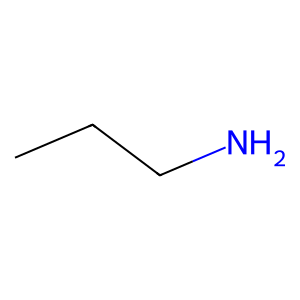 Cas:107-10-8

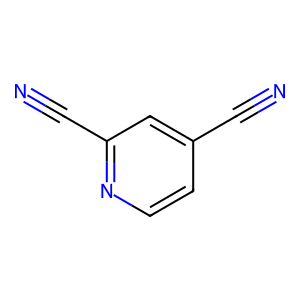 Cas:29181-50-8

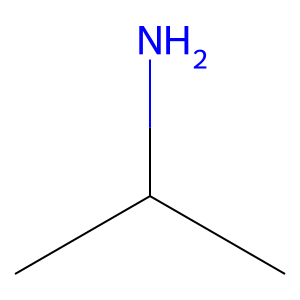 Cas:75-31-0
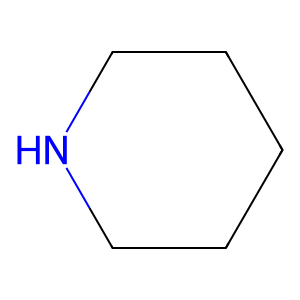 Cas:110-89-4