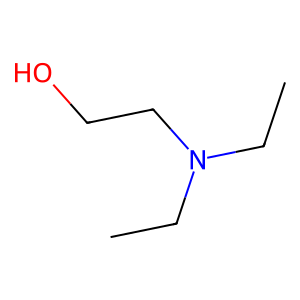
2-Diethylaminoethanol
Names and Identifiers of 2-Diethylaminoethanol
CAS Number |
100-37-8 |
|---|---|
EC Number |
202-845-2 |
IUPAC Name |
2-(diethylamino)ethanol |
InChI |
InChI=1S/C6H15NO/c1-3-7(4-2)5-6-8/h8H,3-6H2,1-2H3 |
InChIKey |
BFSVOASYOCHEOV-UHFFFAOYSA-N |
Canonical SMILES |
CCN(CC)CCO |
UNII |
S6DL4M053U |
UN Number |
2686 |
Physical and chemical properties of 2-Diethylaminoethanol
Boiling Point |
325 °F |
|---|---|
Decomposition |
When heated to decomposition it emits toxic fumes of /nitrogen oxides/. |
Density |
0.89 |
Exact Mass |
117.115364 |
Flash Point |
126 °F |
Freezing Point |
-70℃ |
Index of Refraction |
SADTLER REFERENCE NUMBER: 143 (IR, PRISM); INDEX OF REFRACTION: 1.4412 @ 20 °C/D |
LogP |
0.46 |
Melting Point |
-94 °F |
Molecular Formula |
C6H15NO |
Molecular Weight |
117.189 |
Odor |
Nauseating, ammonia-like odor. |
PSA |
23.47000 |
Stability |
Stable. Flammable. Incompatible with strong oxidizing agents, acids. Moisture sensitive. Hygroscopic. |
Vapour density |
4.03 |
Vapour Pressure |
1 mmHg |
Water Solubility |
soluble |
Safety Information of 2-Diethylaminoethanol


Applications of 2-Diethylaminoethanol
2-(Diethylamino)ethanol has diverse applications across various industries:
- Pharmaceuticals: Used as a precursor for local anesthetics like procaine and other pharmaceutical compounds.
- Corrosion Inhibitor: Effective in steam and condensate lines by neutralizing carbonic acid and scavenging oxygen .
- Ion Exchange Chromatography: Serves as a precursor for DEAE-cellulose resin, widely used in biochemical applications .
- Surface Tension Reduction: Can decrease the surface tension of water at elevated temperatures .
- pH Stabilizer: Functions as a stabilizer in various chemical processes.
Interaction Studies of 2-Diethylaminoethanol
Studies have shown that 2-(Diethylamino)ethanol can absorb carbon dioxide from its environment, indicating potential applications in gas absorption technologies . Additionally, its reactivity with other chemicals highlights the importance of understanding its interactions for safe handling and application in industrial processes.
Biological Activity of 2-Diethylaminoethanol
Research indicates that metabolites of 2-(Diethylamino)ethanol include 2-(diethylamino)ethanol N-oxide and diethylaminoacetic acid. These metabolites may have biological significance, although specific studies on their pharmacological effects remain limited . The compound itself is known to be an irritant to the skin, eyes, and respiratory system, necessitating appropriate safety measures during handling .
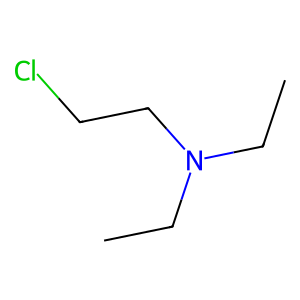 Cas:100-35-6

 Cas:107-21-1

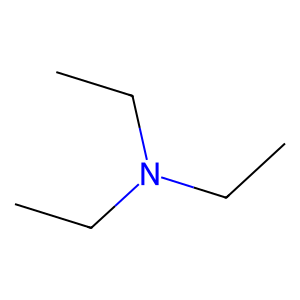 Cas:121-44-8
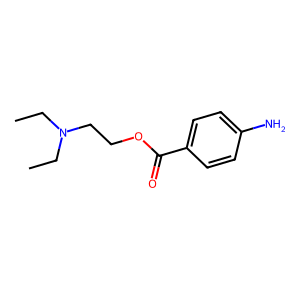 Cas:59-46-1