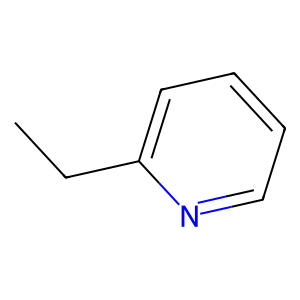
2-Ethylpyridine
Names and Identifiers of 2-Ethylpyridine
CAS Number |
100-71-0 |
|---|---|
EC Number |
202-881-9 |
MDL Number |
MFCD00006361 |
IUPAC Name |
2-ethylpyridine |
InChI |
InChI=1S/C7H9N/c1-2-7-5-3-4-6-8-7/h3-6H,2H2,1H3 |
InChIKey |
NRGGMCIBEHEAIL-UHFFFAOYSA-N |
Canonical SMILES |
CCC1=CC=CC=N1 |
UNII |
06X1W46PYX |
UNSPSC Code |
12352100 |
Physical and chemical properties of 2-Ethylpyridine
Acidity coefficient |
5.89(at 25℃) |
|---|---|
Boiling Point |
150.3±3.0 °C at 760 mmHg |
BRN |
106480 |
Density |
0.9±0.1 g/cm3 |
Exact Mass |
107.073502 |
Flash Point |
29.4±0.0 °C |
Index of Refraction |
1.499 |
LogP |
1.72 |
Melting Point |
-63°C |
Molecular Formula |
C7H9N |
Molecular Weight |
107.153 |
PSA |
12.89000 |
Solubility |
42g/l |
Storage condition |
Flammables area |
Vapour Pressure |
4.89 [mmHg] |
Water Solubility |
ca 45 g/L (20 ºC) |
Safety Information of 2-Ethylpyridine


Applications of 2-Ethylpyridine
2-Ethylpyridine finds applications across various fields:
- Chemical Intermediate: It serves as an important intermediate in the synthesis of pharmaceuticals and agrochemicals.
- Solvent: Due to its polar nature, it is used as a solvent in organic reactions.
- Flavoring Agent: It is also utilized in small quantities as a flavoring agent in food products, although this use is limited due to safety regulations.
Interaction Studies of 2-Ethylpyridine
Interaction studies involving 2-ethylpyridine often focus on its effects on biological systems and its reactivity with other chemicals. For instance, investigations into its role as a cigarette smoke component have revealed its potential to induce oxidative stress and cellular damage. Furthermore, studies examining its interactions with various catalysts have demonstrated its utility in enhancing reaction efficiencies in synthetic processes.
Biological Activity of 2-Ethylpyridine
Research indicates that 2-ethylpyridine may have biological effects, particularly in relation to its presence in cigarette smoke. Studies have shown that it can cause mitochondrial damage in human retinal pigment epithelial cells, suggesting potential cytotoxic effects. Additionally, derivatives of 2-ethylpyridine have been investigated for their anti-tubercular properties, specifically inhibiting mycolic acid synthesis in Mycobacterium tuberculosis.
Physical sample testing spectrum (NMR) of 2-Ethylpyridine

 Cas:10034-85-2

 Cas:103-74-2

 Cas:109-06-8
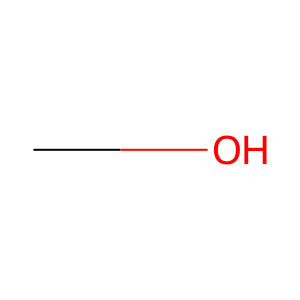 Cas:67-56-1