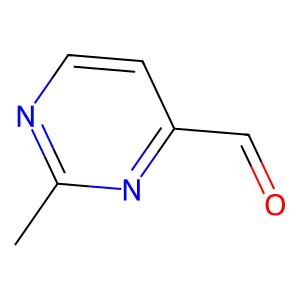
2-Methylpyrimidine-4-carbaldehyde
CAS No.:
1004-17-7
M. Wt:
122.125
M. Fa:
C6H6N2O
InChI Key:
BXHGNAADUUXBKK-UHFFFAOYSA-N
Appearance:
Yellow Solid
Names and Identifiers of 2-Methylpyrimidine-4-carbaldehyde
CAS Number |
1004-17-7 |
|---|---|
MDL Number |
MFCD09832936 |
IUPAC Name |
2-methylpyrimidine-4-carbaldehyde |
InChI |
InChI=1S/C6H6N2O/c1-5-7-3-2-6(4-9)8-5/h2-4H,1H3 |
InChIKey |
BXHGNAADUUXBKK-UHFFFAOYSA-N |
Canonical SMILES |
CC1=NC=CC(=N1)C=O |
UNSPSC Code |
12352100 |
Physical and chemical properties of 2-Methylpyrimidine-4-carbaldehyde
Acidity coefficient |
0.16±0.23(Predicted) |
|---|---|
Boiling Point |
213.7±13.0 °C at 760 mmHg |
Density |
1.2±0.1 g/cm3 |
Exact Mass |
122.048012 |
Flash Point |
85.0±26.3 °C |
Index of Refraction |
1.569 |
LogP |
0.50 |
Molecular Formula |
C6H6N2O |
Molecular Weight |
122.125 |
PSA |
42.85000 |
Storage condition |
under inert gas (nitrogen or Argon) at 2-8°C |
Vapour Pressure |
0.2±0.4 mmHg at 25°C |
Safety Information of 2-Methylpyrimidine-4-carbaldehyde

Applications of 2-Methylpyrimidine-4-carbaldehyde
2-Methylpyrimidine-4-carbaldehyde finds applications across various fields:
- Pharmaceuticals: It serves as an intermediate in the synthesis of biologically active compounds, particularly in drug development.
- Agricultural Chemicals: The compound may be used in developing agrochemicals due to its potential biological activity.
- Material Science: Its derivatives may play a role in creating new materials with specific properties.
The diverse applications underscore its significance in both industrial and research settings.
Interaction Studies of 2-Methylpyrimidine-4-carbaldehyde
Interaction studies involving 2-methylpyrimidine-4-carbaldehyde focus on its reactivity with different biological molecules. Research indicates that:
- The compound may interact with enzymes, potentially leading to inhibition or modulation of enzymatic activity.
- Its interactions with nucleic acids could influence biochemical pathways, although specific studies are required for detailed insights.
Understanding these interactions is crucial for evaluating its therapeutic potential and safety profile.
Physical sample testing spectrum (NMR) of 2-Methylpyrimidine-4-carbaldehyde

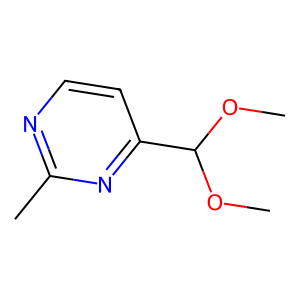 Cas:175277-33-5
