
2-Methylthiazole-5-carbaldehyde
Names and Identifiers of 2-Methylthiazole-5-carbaldehyde
CAS Number |
1003-60-7 |
|---|---|
EC Number |
692-702-4 |
MDL Number |
MFCD09864617 |
IUPAC Name |
2-methyl-1,3-thiazole-5-carbaldehyde |
InChI |
InChI=1S/C5H5NOS/c1-4-6-2-5(3-7)8-4/h2-3H,1H3 |
InChIKey |
YELBTTSDCRQQRE-UHFFFAOYSA-N |
Canonical SMILES |
CC1=NC=C(S1)C=O |
UNSPSC Code |
12352100 |
Physical and chemical properties of 2-Methylthiazole-5-carbaldehyde
Acidity coefficient |
1.66±0.10(Predicted) |
|---|---|
Boiling Point |
219.0±13.0 °C at 760 mmHg |
Density |
1.3±0.1 g/cm3 |
Exact Mass |
127.009186 |
Flash Point |
86.2±19.8 °C |
Index of Refraction |
1.601 |
LogP |
0.52 |
Molecular Formula |
C5H5NOS |
Molecular Weight |
127.164 |
PSA |
58.20000 |
Storage condition |
Inert atmosphere,Store in freezer, under -20°C |
Vapour Pressure |
0.1±0.4 mmHg at 25°C |
Safety Information of 2-Methylthiazole-5-carbaldehyde

Applications of 2-Methylthiazole-5-carbaldehyde
2-Methylthiazole-5-carbaldehyde has several notable applications:
- Pharmaceuticals: Its biological activity makes it a candidate for drug development, particularly in creating compounds with antitumor properties.
- Flavoring and Fragrance: The unique odor profile allows it to be used in flavoring agents and perfumes.
- Chemical Synthesis: It serves as an intermediate in synthesizing other thiazole derivatives and complex organic molecules.
Interaction Studies of 2-Methylthiazole-5-carbaldehyde
Interaction studies involving 2-Methylthiazole-5-carbaldehyde have focused on its reactivity with various biological targets. These studies often assess its potential as an inhibitor or modulator of specific enzymes or receptors, contributing to its evaluation as a therapeutic agent. Additionally, its role in cross-coupling reactions suggests potential interactions with transition metals like palladium, enhancing its utility in synthetic organic chemistry.
Biological Activity of 2-Methylthiazole-5-carbaldehyde
Research indicates that 2-Methylthiazole-5-carbaldehyde exhibits various biological activities, particularly in antitumor and cytotoxic effects. Its mechanism of action may involve interactions at a cellular level, potentially influencing pathways related to cell proliferation and apoptosis. Thiazoles, including this compound, have been studied for their ability to participate in cross-coupling reactions, which can lead to the formation of biologically active compounds.
Physical sample testing spectrum (NMR) of 2-Methylthiazole-5-carbaldehyde

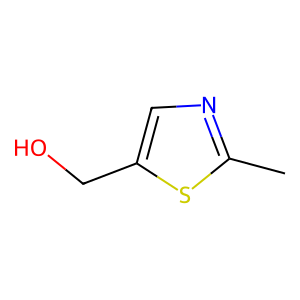 Cas:56012-38-5

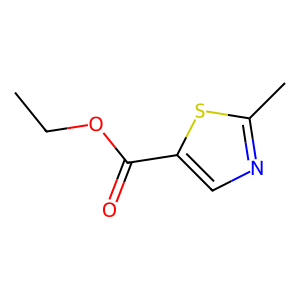 Cas:79836-78-5
 Cas:36437-19-1

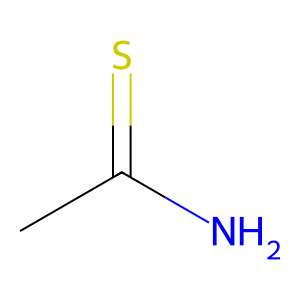 Cas:62-55-5