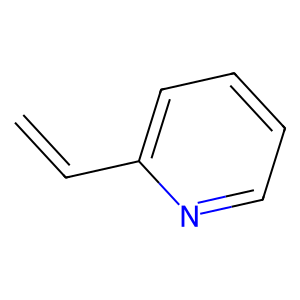
2-Vinylpyridine
Names and Identifiers of 2-Vinylpyridine
CAS Number |
100-69-6 |
|---|---|
EC Number |
202-879-8 |
MDL Number |
MFCD00006355 |
IUPAC Name |
2-ethenylpyridine |
InChI |
InChI=1S/C7H7N/c1-2-7-5-3-4-6-8-7/h2-6H,1H2 |
InChIKey |
KGIGUEBEKRSTEW-UHFFFAOYSA-N |
Canonical SMILES |
C=CC1=CC=CC=N1 |
UNII |
DT4UV4NNKX |
UNSPSC Code |
12352100 |
Physical and chemical properties of 2-Vinylpyridine
Acidity coefficient |
pK1:4.98(+1) (25°C) |
|---|---|
Boiling Point |
159-160 °C |
BRN |
104505 |
Decomposition |
When heated to decomp ... emits toxic fumes of /nitrogen oxides/. |
Density |
Relative density (water = 1): 1.00 |
Exact Mass |
105.057846 |
explosive limit |
1.3-10.7%(V) |
Flash Point |
42 °C |
Index of Refraction |
MAX ABSORPTION (ALCOHOL): 238 NM (LOG E= 4.1); 282 NM (LOG E= 3.8); INDEX OF REFRACTION: 1.5495 AT 20 °C/D; SADTLER REFERENCE NUMBER: 15806 (IR, PRISM); 155 (NMR, VARIAN) |
LogP |
1.39 |
Melting Point |
-50 °C |
Molecular Formula |
C7H7N |
Molecular Weight |
105.137 |
Odor |
Pungent unpleasant odor |
pH |
8 (100g/l, H2O, 20℃) |
PSA |
12.89000 |
Solubility |
Solubility in water: moderate |
Stability |
Unstable; may be stabilized with a small amount of ter-butyl catechol. Heat sensitive - store cold. Flammable. Incompatible with strong oxidizing agents, strong bases, strong acids. |
Storage condition |
Store at -20°C. |
Vapour Pressure |
Vapor pressure, kPa at 44.5 °C: 1.33 |
Water Solubility |
2.5 g/100 mL (20 ºC) |
Safety Information of 2-Vinylpyridine


Applications of 2-Vinylpyridine
2-Vinylpyridine has diverse applications across various industries:
- Polymer Production: It serves as a co-monomer in producing specialty polymers such as latex terpolymers used in tire cord applications. It enhances bonding between rubber and tire cords when copolymerized with styrene and butadiene.
- Organic Synthesis: The compound is utilized as an intermediate for synthesizing pharmaceuticals and agrochemicals. Its ability to react with nucleophiles makes it valuable in creating complex organic molecules.
- Dyes and Coatings: Due to its reactivity, 2-vinylpyridine is also used in dye manufacturing and coatings where specific chemical properties are required.
Interaction Studies of 2-Vinylpyridine
Research has shown that 2-vinylpyridine can form organometallic complexes through C–H activation processes, particularly with transition metals like rhodium. These studies reveal insights into its reactivity patterns and potential applications in catalysis. The interaction between 2-vinylpyridine and various catalysts has been explored to enhance reaction efficiencies and product selectivities.
Biological Activity of 2-Vinylpyridine
The biological activity of 2-vinylpyridine has been explored in several contexts. Notably, it has been found to be a precursor in the synthesis of veterinary anthelmintics through its reaction with methanol, leading to compounds that exhibit anthelmintic properties. Additionally, derivatives of 2-vinylpyridine have been investigated for their potential pharmaceutical applications, including the synthesis of Axitinib, a drug used in cancer therapy.
Physical sample testing spectrum (NMR) of 2-Vinylpyridine

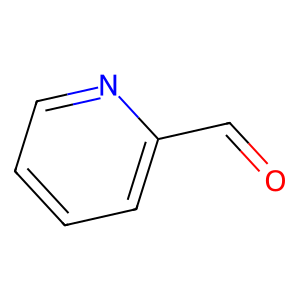 Cas:1121-60-4

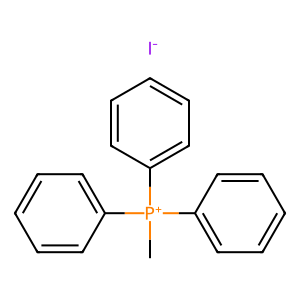 Cas:2065-66-9

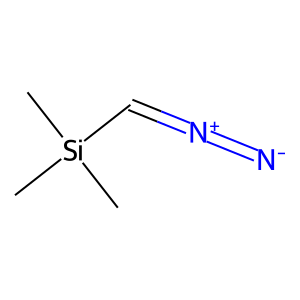 Cas:18107-18-1
 Cas:109-06-8
 Cas:50-00-0